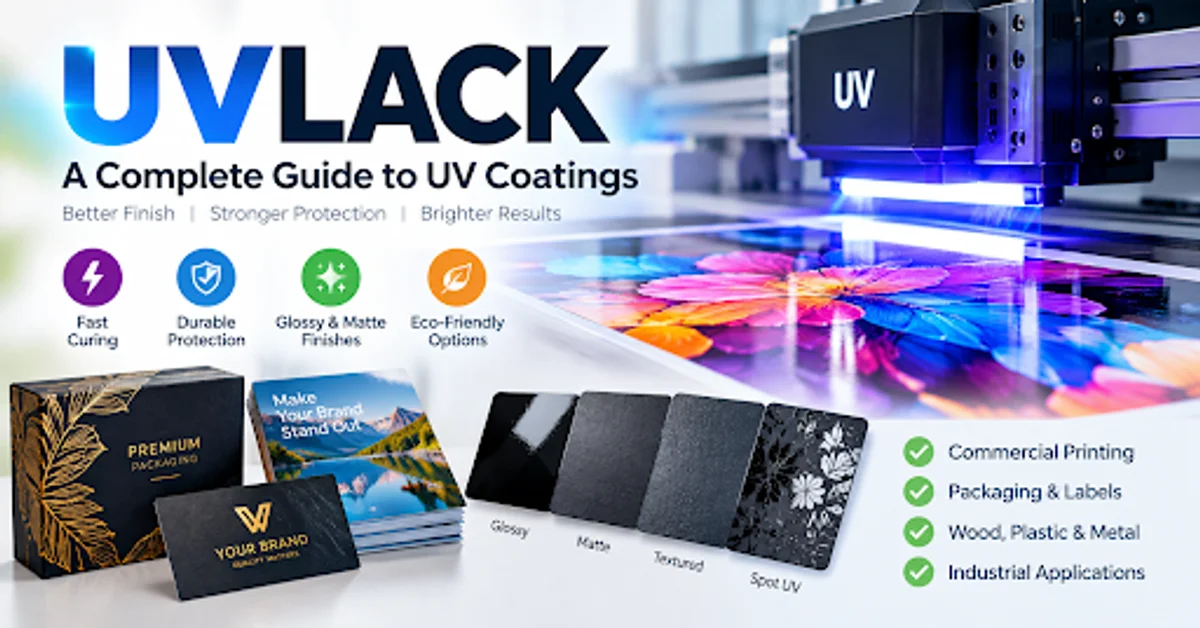
UVLACK is used here to describe a UV-curable varnish or lacquer. In coating terminology, Lack is a German word for lacquer, and similar terms appear in European printing and finishing industries. UVLACK is not necessarily one standardized chemical formula or a single manufacturer’s product; its precise meaning can depend on the supplier and application.
A UVLACK coating is designed to change from a liquid layer into a solid film when exposed to suitable ultraviolet energy. Depending on its formulation, it can produce glossy, matte, textured, or selective decorative effects. This makes it useful for both visual enhancement and surface finishing.
The UVLACK curing process typically begins when a liquid coating is applied to a prepared surface. The material then passes under compatible UV curing lamps or another suitable UV source. Light activates photoinitiators in the formulation, starting a chemical reaction that causes reactive ingredients to link together and form a solid coating.
This reaction, known as polymerization, can happen within seconds under suitable conditions. Formulations may contain monomers, oligomers, photoinitiators, and other additives selected to achieve specific performance characteristics. The correct combination determines properties such as flexibility, adhesion, hardness, and surface appearance.
Related: Sodziu: Meaning, History, and Lithuanian Village Life
Key Features and Benefits of UVLACK
Fast Curing and Production Efficiency
One of the leading UVLACK benefits is its fast curing technology. Conventional coatings may require extended drying periods, depending on their chemistry and application. UV-curable varnishes can harden rapidly under suitable ultraviolet exposure, allowing printed sheets and manufactured components to move to subsequent production stages sooner. This can reduce waiting time and improve production planning.
For commercial printing and industrial manufacturing, faster handling can help reduce production bottlenecks and make better use of available space. However, curing speed varies with lamp output, coating thickness, formulation, and line speed. Businesses should test the complete process instead of assuming every UVLACK product cures instantly under all conditions.
Surface Protection and Durability
UVLACK surface coating can create a protective surface layer that improves resistance to abrasion, scratches, and moisture. These properties are useful for printed cards, labels, packaging, and other products that experience frequent handling. Depending on the formulation, a UV varnish may also provide chemical resistance and help maintain the finish’s appearance.
However, UVLACK durability is not identical across all products. A thin print varnish and an industrial protective coating are designed for different demands. Their performance depends on the substrate, coating thickness, curing quality, and intended environment. Selecting a coating that matches the actual conditions is the best way to achieve dependable results.
Common Types of UVLACK Finishes
Glossy, Matte, and Textured Finishes
UVLACK finish types offer different visual and tactile effects. A glossy coating creates a reflective surface that can make photographs and colorful graphics appear more vivid. A matte coating produces a softer, less reflective appearance, making it suitable for understated designs and certain premium products. Textured coatings can add a distinctive feel that encourages people to notice a product through touch as well as sight.
The right finish depends on the design and practical purpose. A high-gloss finish may suit colorful packaging, while matte finishes can complement minimalist branding. Some specialty coatings produce raised or tactile effects, but these results require compatible formulations and application methods. Testing samples helps designers compare appearance, readability, and handling before choosing a final finish.
Full-Surface Coating vs. Spot UV Varnish
A full-surface coating covers most or all of the intended printed area. It creates a consistent finish across paper and cardboard products, including brochures, magazines, labels, and packaging. Depending on the varnish, it can improve visual uniformity and provide a degree of protection against everyday handling.
Spot UV varnish, also known as partial UV varnish, is applied only to selected elements. A designer might highlight a logo, heading, image, or decorative pattern against a matte background. This contrast creates visual depth without requiring additional ink colors. Successful spot UV printing depends on accurate alignment and compatibility between the coating, inks, and underlying material.
Applications of UVLACK in Different Industries
Commercial Printing and Packaging
The printing industry uses UV Coating to enhance many familiar products. Business cards, brochures and magazines, product labels, promotional materials, and retail packaging can all benefit from suitable surface finishing. The coating may improve gloss, add tactile interest, and help protect printed graphics during handling and distribution.
The packaging industry also uses specialized UV-curable finishes to create attractive retail presentation. For example, a cosmetics box might feature a matte background with a glossy brand name, while a food-product label may need a coating selected for moisture resistance and printing compatibility. Packaging intended for direct or indirect food contact requires particular care: the coating must meet applicable regulatory and migration requirements for its intended use.
Industrial Coatings for Wood, Plastic, and Metal
UVLACK industrial applications extend beyond printed paper. Wood coatings can be used on furniture panels, flooring, cabinets, and decorative components. Plastic coatings may improve the appearance and wear resistance of selected consumer products, while metal coatings can provide a finished surface for compatible industrial or decorative parts. UV-curable systems are used across these sectors, although the exact formulation varies by application.
Manufacturers value rapid curing when it supports continuous production. Nevertheless, not every substrate responds equally well to every UV lacquer. Surface preparation, flexibility, heat sensitivity, and exposure conditions all influence the result. Industrial trials should confirm adhesion and durability before a coating is adopted for large-scale production.
UVLACK in Packaging and Product Design
Enhancing Brand Appeal and Visual Quality
Packaging often creates a customer’s first impression of a product. A carefully selected UVLACK finish can help a brand communicate quality through color, shine, contrast, and texture. A well-executed coating may make product photographs clearer, give a logo greater visual prominence, or create a refined appearance without changing the package’s basic design.
Visual appeal works best when it supports the product’s identity. A premium technology brand may prefer restrained matte packaging with selective gloss, while a colorful retail product may benefit from a more reflective finish. Designers should also consider readability, shelf lighting, fingerprints, and the practical demands of transportation.
Creating Premium Packaging with Spot Coating
Spot coating offers a flexible way to emphasize specific design features. A package can use a matte or uncoated background while applying a high-gloss layer to a logo, product name, or illustration. This difference in reflectivity catches the light and adds depth, helping the design stand out without making every surface equally shiny.
The effect depends on precise registration, appropriate coating thickness, and good adhesion. Designers should prepare artwork that clearly identifies the coated areas and consult the printer about technical requirements. A printed sample is especially useful for checking whether the effect matches the intended design and remains attractive under real retail conditions.
UVLACK vs. Traditional Coating Methods
Differences in Curing Time and Performance
When comparing UVLACK vs. traditional varnish, the main difference is the way the coating hardens. Many conventional coatings rely on solvent or water evaporation, chemical reactions, or a combination of processes. UV-curable coatings use ultraviolet energy to initiate polymerization, allowing rapid curing when the formulation and equipment are correctly matched.
This speed can be valuable for high-volume printing and automated manufacturing. UV Coating may also provide strong gloss, abrasion resistance, or chemical resistance when properly formulated. Traditional coatings remain useful, however, particularly where existing equipment, substrate compatibility, appearance, or application requirements favor them. Neither approach is automatically superior for every project.
Cost, Quality, and Production Considerations
The initial cost of UVLACK may include specialized curing lamps, application equipment, ventilation, maintenance, and staff training. These investments can be worthwhile when faster throughput and reduced drying space deliver measurable operational benefits. A fair comparison should consider the total cost per finished item rather than the price of the coating alone.
Quality also depends on consistent application and curing. An inexpensive coating that produces adhesion failures or rejects may cost more over time than a higher-quality alternative. Businesses should compare production speed, energy consumption, material waste, equipment upkeep, finish quality, and long-term performance before selecting a system.
Environmental Impact and Safety of UVLACK
VOC Emissions and Environmental Considerations
UVLACK environmental impact depends on the coating formulation, curing equipment, energy source, and production practices. Many UV-curable coatings contain little or no conventional solvent and can reduce volatile organic compounds (VOCs) compared with some solvent-based alternatives. This may help manufacturers reduce certain air emissions. However, UV-curable products are not automatically VOC-free or environmentally harmless.
Sustainable coating solutions require a broader assessment. Businesses should examine ingredient safety, energy consumption, waste, packaging recyclability, and the effect of the finish on paper or plastic recycling. Product-specific technical data sheets and safety data sheets provide a more reliable basis for environmental decisions than general marketing claims.
Safe Handling and UV Curing Equipment
UV curing equipment requires appropriate safety measures. Direct exposure to ultraviolet radiation can injure the eyes and skin, while certain lamps and processes may generate ozone or other workplace hazards. Facilities should use properly enclosed equipment, effective ventilation where required, suitable protective equipment, and established operating procedures.
Uncured coatings also require careful handling because some ingredients can irritate the skin or cause sensitization. Workers should follow the manufacturer’s safety instructions, avoid direct contact, and use recommended cleaning procedures. Safe handling protects employees while supporting consistent production quality.
How to Choose the Right UVLACK Coating
Selecting the Best Finish for Your Material
Choosing the right UVLACK coating starts with identifying the material and desired result. Paper and cardboard used for brochures may need a different varnish from plastic packaging or a wooden furniture panel. The intended appearance also matters: glossy, matte, textured, and spot finishes serve different design goals.
Next, consider the product’s environment. A promotional card may need basic resistance to handling, whereas an industrial component could require stronger abrasion or chemical resistance. Ask the supplier for technical specifications, compatibility information, and recommendations for the intended use. Comparing sample finishes can prevent costly mistakes.
Factors Affecting Coating Quality and Adhesion
Coating adhesion is essential to a reliable finish. Dust, grease, surface energy, printing inks, and unsuitable primers can interfere with bonding. The coating must also receive sufficient UV energy to cure correctly. Lamp condition, wavelength, conveyor speed, coating thickness, and formulation all influence the curing result.
Quality control should include appropriate adhesion, scratch, and appearance tests. Depending on the application, manufacturers may also assess flexibility, moisture resistance, and chemical resistance. Testing should follow relevant technical procedures and acceptance criteria rather than relying only on whether a surface looks dry.
Limitations and Challenges of UVLACK
Equipment Costs and Curing Requirements
Although UVLACK offers important advantages, the technology has practical limitations. UV curing lamps, compatible coating units, maintenance, and safety systems can require substantial investment. Smaller printers may need to assess whether expected production volumes justify the cost or whether an outside finishing service is more economical.
Curing requirements can also restrict production choices. The coating must receive sufficient UV energy, and some thick, pigmented, or light-blocking layers can be difficult to cure completely. Manufacturers should verify that the equipment, coating formulation, and production speed work together before committing to a new process.
Material Compatibility and Quality Control
Not every surface bonds well with every UVLACK lacquer. Certain plastics have low surface energy, while flexible materials may require coatings that resist cracking. Printed inks, existing finishes, and surface treatments can also affect compatibility. Without appropriate testing, problems such as peeling, poor adhesion, tackiness, or uneven gloss may appear.
Quality control reduces these risks. A small production trial allows the team to assess curing, adhesion, finish consistency, and resistance under realistic conditions. Suppliers can help identify suitable formulations and pretreatment methods, but final acceptance should be based on the finished product’s actual requirements.
The Future of UVLACK Technology
Innovations in UV-Curable Coatings
UVLACK technology continues to benefit from advances in coating chemistry and curing equipment. UV LED systems, for example, can offer targeted wavelengths, lower heat output, and potential energy savings in suitable applications. These characteristics can help manufacturers process certain heat-sensitive materials while improving control over production conditions.
Research and product development also focus on improved adhesion, durability, flexible finishes, and formulations suited to specialized substrates. Progress does not eliminate the need for testing. Each new coating must still meet the performance, safety, and regulatory requirements of its intended application.
Trends in Sustainable Printing and Manufacturing
Demand for efficient manufacturing and attractive packaging is encouraging businesses to evaluate UV-curable systems alongside other finishing technologies. Faster curing, lower solvent requirements in suitable formulations, and compatibility with automated production can make UV Coating a practical option for selected operations.
Future progress will depend on balancing performance with environmental responsibility. Better formulations, efficient UV LED equipment, careful chemical management, and improved waste handling may help reduce environmental impacts. The best solution will remain the one that meets the product’s needs while using resources responsibly.
Related: Mannacote: Meaning, Recipe, and Italian Food Traditions
Frequently Asked Questions
What does UVLACK mean?
UVLACK refers here to a UV-curable varnish or lacquer. It hardens when exposed to suitable ultraviolet energy and can provide decorative and protective surface finishes.
What are the main benefits of UVLACK?
Its potential benefits include fast curing, attractive gloss or matte finishes, improved surface durability, and reduced waiting time between production stages. Actual performance depends on the formulation and application.
Is UVLACK suitable for packaging?
Yes. Suitable UV Coating are used on boxes, labels, cartons, and other printed packaging. Food-contact applications require additional checks to ensure regulatory compliance and appropriate migration performance.
Is UVLACK environmentally friendly?
Some UV-curable coatings have low VOC emissions and can reduce solvent use. However, environmental performance depends on formulation, energy use, waste, and the full production process.
How long does UVLACK take to cure?
Some UV-curable coatings harden in seconds or less under suitable conditions. The actual curing time depends on the coating, UV source, layer thickness, and production speed.
Summary
UVLACK offers a useful combination of surface finishing, visual appeal, and production efficiency. In commercial printing, it can enhance business cards, brochures, magazines, labels, and packaging. In industrial manufacturing, suitable UV-curable coatings can provide attractive finishes and practical protection for selected wood, plastic, and metal products.
The key to success is choosing the right formulation for the material and intended environment. Businesses should evaluate curing performance, adhesion, durability, cost, and safety before selecting a coating system. Environmental claims should also be supported by product-specific information rather than assumptions.
When carefully selected and properly applied, UVLACK can help manufacturers create polished, durable products while supporting efficient workflows. Its real value lies not simply in a glossy finish, but in finding the right balance between appearance, performance, and responsible production.