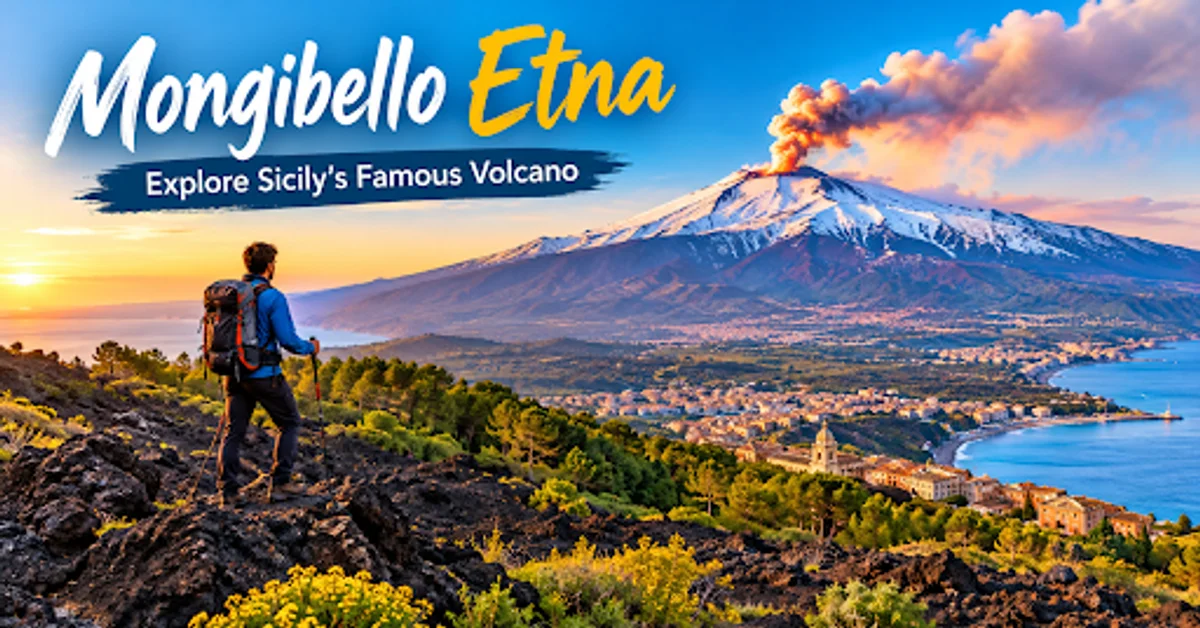
Mongibello Etna refers to, the celebrated active volcano that dominates eastern Sicily. It is a prominent example of an active stratovolcano, a type of volcano formed through repeated eruptions that build layers of lava, ash, and other volcanic material. Its appearance changes over time as eruptions reshape its summit and create new formations across its slopes.
The mountain stands above the surrounding towns and countryside, creating a striking contrast between volcanic wilderness and cultivated land. Its volcanic landscape includes rugged craters, ancient lava flows, forests, and high-altitude areas where snow may remain even when coastal Sicily is warm.
The Mongibello meaning is commonly explained through the combination of Latin mons, meaning mountain, and Arabic jabal or jebel, also meaning mountain. The name reflects the cultural and linguistic influences that have shaped Sicily throughout its history. It is traditionally associated with Mongibello Etna rather than a separate volcano.
The expression is often interpreted as “mountain of mountains,” although it is sometimes popularly translated as “beautiful mountain.” These explanations should not be confused with a single definitive translation. The name itself reflects the importance of this enormous Sicilian mountain in local identity, history, and storytelling.
Related: Pasonet: Features, Benefits, and How It Works
Where Is Mongibello Etna Located?
Mongibello Etna’s Location in Eastern Sicily
Mongibello Etna is situated on the eastern side of Sicily, the largest island in the Mediterranean Sea. It rises above the metropolitan area of Catania and is visible from many parts of the surrounding region. Its slopes extend across a wide area, creating a remarkable landscape of volcanic rock, forests, agricultural land, and mountain communities.
The volcano is part of the Etna Regional Nature Park, which protects important natural environments and hiking routes. Its UNESCO-listed area covers approximately 19,237 hectares. The mountain’s location also makes it a useful starting point for exploring eastern Sicily, including coastal towns, historic settlements, and scenic countryside.
Nearby Towns, Landscapes, and Attractions
Catania is one of the main gateways to Mongibello Etna. Visitors can use the city as a base for arranging transport, guided excursions, accommodation, and other travel services. The nearby town of Linguaglossa provides access to the northern side, including the mountain station at Piano Provenzana.
The surrounding landscape offers many different experiences. Valle del Bove is a vast volcanic depression shaped by geological processes, while the Aeolian Islands and the volcanic island of Stromboli provide additional destinations for travelers exploring Sicily’s wider volcanic heritage. On clear days, elevated viewpoints on Etna may offer distant views toward Calabria across the Strait of Messina. Visibility depends on weather and atmospheric conditions.
The Volcanic History of Mongibello Etna
Major Eruptions and Geological Formation
Mongibello Etna has developed through a long sequence of volcanic activity. Successive eruptions have deposited lava, ash, and other materials, gradually building the mountain and reshaping its slopes. Scientists study these geological formations to understand how magma moves beneath the surface, how eruptions develop, and how volcanic landscapes change over time.
The mountain’s eruption history includes both major destructive events and smaller episodes that create new craters or lava fields. The 1669 eruption, for example, produced extensive lava flows that reached areas near Catania. More recent eruptions have repeatedly altered the summit and surrounding terrain. Because its shape and activity can change, published measurements of the mountain’s height should be treated as time-sensitive rather than permanent.
Summit Craters, Lava Flows, and Volcanic Activity
The summit area contains several major craters, including Bocca Nuova and Voragine Crater, alongside the northeastern and southeastern crater systems. Their appearance and activity vary. Visitors may sometimes see steam or gas rising from volcanic openings, but visible explosions and active lava are not guaranteed parts of a tour.
The National Institute of Geophysics and Volcanology (INGV) monitors Etna’s activity using scientific instruments and observations. Its work helps authorities assess volcanic conditions, but monitoring cannot eliminate the danger or predict every event with certainty. Volcanic ash and lava flows can change the terrain, damage infrastructure, and prompt temporary restrictions. Always consult current official notices before planning an ascent.
Hiking and Climbing Mongibello Etna
Popular Routes From Rifugio Sapienza and Piano Provenzana
Mongibello Etna hiking usually begins from one of two main access areas. On the southern side, Rifugio Sapienza provides access to the Silvestri Craters, mountain facilities, and the Mongibello Etna cable car. When operating, the cable car can take visitors to approximately 2,500 metres, with authorised vehicles and guided walking routes sometimes allowing travel farther uphill.
Piano Provenzana, on the northern side near Linguaglossa, offers a different atmosphere. Its surroundings include pine forests, lava formations, and evidence of the 2002 eruption. The north is often considered quieter and more wooded, while the southern approach generally has more visitor infrastructure. Routes and transport services vary with the season, weather, and volcanic restrictions.
Guided Tours, Difficulty Levels, and Hiking Preparation
Mongibello Etna hiking trails range from accessible walks around older craters to demanding high-altitude excursions. Exploring the lower slopes can be suitable for many visitors with reasonable mobility, while summit-area hikes require stronger fitness, suitable equipment, and careful attention to conditions. The Mongibello Etna hiking difficulty depends on elevation, terrain, wind, temperature, snow, and the length of the route.
A qualified local guide is strongly recommended for high-altitude exploration and is required in restricted areas under applicable rules. Mongibello Etna guided tours can also help visitors understand the mountain’s geology and choose a suitable itinerary. Before booking, ask about walking time, elevation gain, transport, equipment, and cancellation arrangements. The summit should be treated as a possible goal, not a guaranteed destination.
Best Time to Visit Mongibello Etna
Spring and Summer Hiking Conditions
The Mongibello Etna best time to visit depends on the experience you want. Spring brings fresh vegetation and wildflowers to parts of the lower mountain, while longer summer days can provide good opportunities for hiking and sightseeing. However, popular access points may be busy, and temperatures can vary greatly between the coast and higher elevations.
April through September is often a useful general period for planning non-winter hikes, but it is not a guarantee of suitable conditions. Snow can persist at high elevations, strong winds may reduce visibility, and volcanic activity can close routes at any time. Check the forecast and access rules shortly before departure rather than relying on seasonal averages alone.
Winter Adventures, Snowshoeing, and Skiing
Winter transforms Mongibello Etna into a snow-covered volcano where white slopes meet dark lava fields. Depending on conditions, visitors may enjoy skiing, snowshoe hiking, guided winter walks, and views of volcanic formations beneath the snow. Ski facilities operate around Rifugio Sapienza in the south and Piano Provenzana in the north when weather and operational conditions permit.
Winter mountaineering is substantially more demanding than ordinary sightseeing. Ice, deep snow, strong winds, and concealed terrain can make routes hazardous. Crampons, ice axes, and other technical equipment may be necessary for certain excursions, together with the knowledge to use them correctly. Visitors without mountaineering experience should choose an appropriate guided activity rather than attempting a winter summit independently.
Safety Tips for Exploring Mongibello Etna
Volcanic Hazards, Weather, and Summit Restrictions
Mongibello Etna is closely monitored, but it remains an active and unpredictable volcano. Potential hazards include sudden eruptions, volcanic gases, falling ash, unstable ground, rockfalls, and rapidly changing weather. Gas can collect in dangerous concentrations in some areas, while wind may carry ash or fumes toward visitors. Even when the volcano appears quiet, risk is never completely absent.
Follow instructions from local authorities, park staff, and authorised guides. Summit access may be limited or prohibited according to volcanic activity, alert levels, and weather. Never cross barriers or approach crater rims against official guidance. The Sicilian Civil Protection Department advises visitors to check current alerts, weather, permitted routes, and relevant restrictions before entering high-risk areas.
Essential Clothing, Equipment, and Guide Recommendations
Good preparation makes a major difference on the mountain. Wear sturdy hiking boots with reliable grip, layered clothing, and a windproof, weather-resistant jacket. Take sufficient water, food, sun protection, a charged mobile phone, and any necessary personal medication. Hiking poles can be helpful on loose volcanic ash and sand, especially during descents.
For high-altitude trips, confirm what equipment your guide supplies and what you must bring yourself. Helmets and specialist mountaineering gear may be required for particular routes. Check the expected duration and difficulty before booking, and be honest about your fitness and experience. These Mongibello Etna safety tips help reduce avoidable risks, but no equipment or guide can make an active volcano entirely risk-free.
Natural Beauty and Wildlife Around Mongibello Etna
Volcanic Caves, Forests, and Unique Landscapes
One of Etna’s greatest attractions is the variety of landscapes found across its slopes. Black lava fields, volcanic cones, rugged ridges, pine forests, and open areas of volcanic ash create scenery that can resemble another planet. These geological formations reveal the mountain’s changing history, with different eruptions leaving distinct textures and colours across the terrain.
The Pista Altomontana is a long trail that follows sections of the mountain’s flanks and passes through varied environments. Visitors can also explore lava caves, including the Grotto of Raspberries, known in Italian as Grotta dei Lamponi. Access to caves and trails should always follow local rules, as some areas may be closed or unsuitable in certain conditions.
Wildlife, Fertile Soil, and Local Agriculture
Although the upper slopes can appear barren, Etna supports rich biodiversity. Vegetation changes with elevation, ranging from cultivated land and woodland to high-altitude volcanic terrain. Different habitats support birds, mammals, insects, and plant species adapted to the mountain’s varied conditions. Visitors should observe wildlife from a distance and avoid disturbing fragile environments.
Volcanic soil and agriculture are also central to the character of the region. Weathered volcanic materials can contribute minerals and nutrients to cultivated soils, although fertility depends on many factors, including soil development, water, and local farming practices. The surrounding countryside is known for products such as grapes, olives, apples, pears, and pistachios. This connection between volcanic geology and agriculture gives the Etna region cultural and economic importance beyond tourism.
Related: Sflix: Features, Safety, and Best Alternatives
Frequently Asked Questions
What does Mongibello Etna mean?
Mongibello is a traditional name for Mongibello Etna. Its linguistic roots combine words associated with “mountain” in Latin and Arabic. The name reflects Sicily’s diverse cultural history, although popular translations such as “beautiful mountain” are not definitive linguistic meanings.
Where is Mongibello Etna located?
Mongibello Etna is located in eastern Sicily, Italy, near the city of Catania. The volcano rises above the Mediterranean coastline and is surrounded by towns, forests, vineyards, and the protected Etna Regional Nature Park.
Is Mongibello Etna safe to visit?
Mongibello Etna can be visited safely when visitors follow official restrictions, choose suitable routes, and respect volcanic hazards. However, it remains an active volcano. Eruptions, gases, ash, and changing weather can create dangerous conditions, so summit access may be restricted at short notice.
What is the best time to hike Mongibello Etna?
Spring and summer are popular for hiking, while winter offers opportunities for snowshoeing and skiing. Conditions vary with elevation and weather, and snow can remain on upper slopes outside winter. Always check current forecasts, volcanic alerts, and route availability before visiting.
Can beginners climb Mongibello Etna?
Beginners can explore suitable lower-altitude trails and accessible crater areas without attempting a demanding summit hike. High-altitude routes require greater fitness and preparation, and some areas require an authorised guide. Choose an excursion based on your experience and follow the guide’s instructions.
Summary
Mongibello Etna is an extraordinary destination where natural beauty, geological history, and adventure come together. From the panoramic views near Rifugio Sapienza to the forested northern slopes around Piano Provenzana, every part of the mountain offers a different perspective. Its summit craters, black lava fields, volcanic caves, and fertile countryside reveal how volcanic activity can shape both landscapes and human life.
Whether you are interested in photography, geology, hiking, winter sports, or Sicilian culture, Mongibello Etna offers memorable experiences at different levels of difficulty. The best approach is to plan carefully, respect local restrictions, and choose activities suited to your abilities. With responsible preparation and expert guidance where needed, exploring this remarkable UNESCO World Heritage Site can become a rewarding highlight of any visit to Sicily.