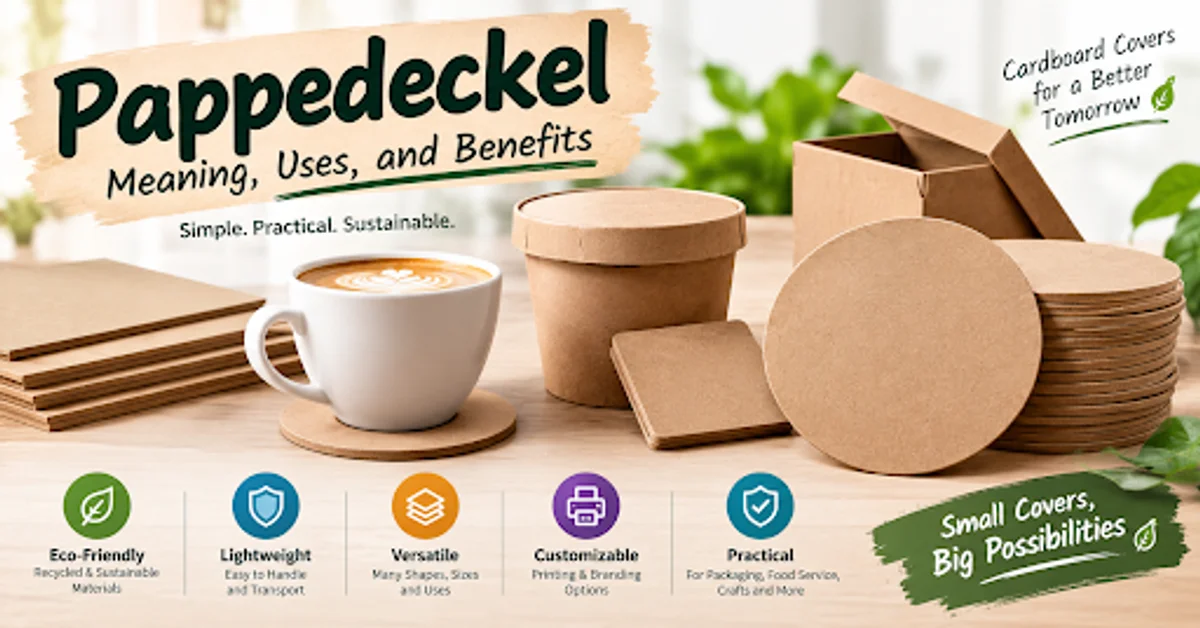
Pappedeckel generally refers to a cardboard lid, paperboard cover, or similar flat component made from compressed paper fibers. The word is associated with everyday objects that cover containers, protect surfaces, separate products, or provide a firm backing. Its precise meaning depends on the product and the context in which it appears.
In practical terms, a Pappedeckel product might be a circular coaster, a rectangular packaging insert, or a rigid cover for a lightweight container. These products can differ in shape, thickness, finish, and strength. Therefore, the term describes a general category rather than one standardized material or specification.
Pappedeckel belongs to the German language and combines elements associated with cardboard and covers. The German word Pappe means cardboard or paperboard, while Deckel means lid or cover. Related spellings include Pappdeckel and Pappendeckel, although regional usage and dictionary conventions can vary.
The Duden German dictionary is a useful reference for checking standard German vocabulary and spelling. When translating Pappedeckel into English, the surrounding context matters. A product listing might be better translated as “cardboard lid,” “paperboard disc,” or “cardboard cover,” depending on its actual function.
Related: Enntal: Complete Travel Guide to Austria
Understanding Cardboard and Paperboard
Differences Between Cardboard and Paperboard
Cardboard and paperboard are often used interchangeably in everyday conversation, but product specifications can distinguish between different grades and structures. Paperboard is generally a relatively thick paper-based material made from bonded cellulose fibers. It may be smooth, rigid, flexible, coated, or constructed from multiple layers.
Corrugated fiberboard has a different structure. It contains a fluted layer between flat sheets, providing cushioning and strength for shipping cartons. By contrast, solid paperboard is often more suitable for flat covers, dividers, and decorative packaging components that need a smooth surface.
Common Materials Used to Make Pappedeckel
The main raw material is commonly wood pulp, which supplies cellulose fibers used to manufacture paper-based products. Depending on the required quality and application, manufacturers may use virgin paper fibers, recycled paper fibers, or a combination of both. Fiber composition influences appearance, stiffness, surface quality, and performance.
Some products also use adhesives, inks, or surface coatings to improve appearance or provide specific properties. These additions should be considered when evaluating durability, food-contact suitability, and recycling options. Choosing the right Pappedeckel material starts with understanding what the finished product must accomplish.
Common Uses of Pappedeckel
Food Packaging and Beverage Coasters
One of the familiar Pappedeckel uses is food and beverage service. Paperboard discs can serve as beverage coasters, helping protect tables from condensation and minor spills. Depending on their construction, they may absorb moisture while providing a convenient surface for glasses, mugs, and bottles.
Cardboard components can also be used in food packaging as dividers, covers, and protective layers. However, general-purpose cardboard should not automatically be used in direct contact with food. The manufacturer must confirm that the material, inks, adhesives, and coatings are suitable for the intended food-contact application and comply with applicable requirements.
Household Storage, Crafts, and Commercial Applications
At home, a Pappedeckel cover can help keep lightweight items organized and reduce dust exposure in storage boxes. Similar pieces can separate photographs, documents, accessories, and craft supplies. Their usefulness is greatest in clean, dry environments because ordinary paperboard can weaken when exposed to moisture.
Creative projects provide another practical application. Students and hobbyists can cut, paint, fold, and decorate cardboard pieces to create models, ornaments, backing boards, and handmade packaging. In the packaging industry, businesses may use standardized or custom cardboard covers to separate products, protect surfaces, and improve presentation during shipping and retail display.
Key Benefits of Pappedeckel
Lightweight, Affordable, and Versatile Design
A major Pappedeckel benefit is its lightweight construction. Compared with many rigid alternatives, paperboard can be easy to transport, handle, cut, and incorporate into packaging. When used in large quantities, lightweight components may also help reduce shipment weight, depending on the alternative material and required performance.
Cost is another advantage, particularly for simple products manufactured in large batches. Paperboard can be produced in different shapes and sizes without making every component unnecessarily complex. However, the cheapest option is not always the best value. A poorly designed cover may bend, tear, or require frequent replacement, increasing the overall cost.
Customization, Printing, and Branding Options
Pappedeckel products offer considerable design flexibility. Manufacturers can create circular discs, rectangular covers, shaped inserts, and other components to match particular containers or products. Die-cutting helps produce consistent shapes, while suitable finishing techniques can improve appearance and usability.
Printing and coating can also transform a simple cardboard sheet into an effective branding surface. Businesses may add logos, product details, instructions, or decorative patterns. Before ordering a large quantity, it is sensible to inspect a sample for color accuracy, print clarity, edge quality, and fit. Coatings should also be evaluated for their effect on recycling and moisture resistance.
How Pappedeckel Is Manufactured
Paper Fibers, Material Thickness, and Stiffness
Pappedeckel manufacturing typically begins with paper-based material produced from wood pulp, recovered paper, or a combination of fibers. These fibers are processed into sheets, which may be pressed or combined in layers to achieve the desired properties. Manufacturing choices influence the finished product’s appearance, rigidity, and consistency.
Thickness is important, but it does not determine strength on its own. Fiber quality, density, layer structure, moisture content, and grain direction can all affect paperboard stiffness. A thicker piece may still perform poorly if its grade is unsuitable for the intended load. Manufacturers should therefore match material specifications to actual operating conditions.
Cutting, Coating, and Finishing Processes
Once the paperboard is prepared, converting processes shape it into the required product. Die-cutting is useful for repeated shapes and larger production runs, while digital cutting can be practical for prototypes and small batches. Accurate cutting helps covers fit containers properly and reduces problems during assembly.
Additional finishing may include printing, embossing, lamination, or surface coating. Moisture-resistant coatings can improve performance in certain conditions, but they do not necessarily make paperboard waterproof. Finishing methods may also affect recyclability. For commercial orders, buyers should specify dimensions, thickness, tolerances, surface quality, and any required performance tests.
Pappedeckel and Environmental Sustainability
Recycled Materials and Responsible Sourcing
Pappedeckel can support sustainable packaging when the material is sourced and manufactured responsibly. Products containing recycled cardboard use recovered fibers and may reduce demand for virgin materials. Responsibly sourced virgin fibers can also be appropriate, depending on forestry practices, manufacturing impacts, and product requirements.
Nevertheless, paper-based does not automatically mean environmentally harmless. Energy use, water consumption, transport, chemical treatments, product lifespan, and disposal all contribute to a product’s overall impact. Buyers should look for specific, verifiable information about recycled content and sourcing rather than relying on broad claims such as “100% eco-friendly.”
Recycling, Reuse, and Waste Reduction
Pappedeckel recycling depends on the product’s composition and the facilities available locally. Clean, uncoated paperboard is often suitable for paper recycling, but plastic laminates, certain coatings, metalized finishes, and food contamination can complicate recovery. Local recycling guidance should determine the correct disposal method.
Reuse is another useful strategy when a component remains clean, dry, and structurally sound. Businesses may reuse suitable dividers during internal packing operations, while households can repurpose cardboard pieces for storage or crafts. Choosing appropriate dimensions and avoiding excessive material can further reduce waste without compromising protection.
How to Choose the Right Pappedeckel
Selecting the Correct Size, Shape, and Thickness
Choosing the right Pappedeckel starts with identifying its purpose. A beverage coaster may need absorbency, while a packaging insert may require rigidity and precise dimensions. Measure the length, width, diameter, and thickness needed for the application. If the piece must fit inside a container, measure the internal space rather than relying on the outside dimensions.
Material thickness should match the expected pressure and handling conditions. Thin paperboard may work well for decorative projects, whereas protective packaging may require a stronger grade. Testing samples before placing a bulk order helps confirm the fit, stiffness, edge quality, and overall packaging durability.
Food Safety, Moisture Resistance, and Durability
Food-related applications require particular attention to hygiene and material suitability. Verify that the product is designed for its intended food-contact use, including any applicable requirements for inks, adhesives, and coatings. A clean appearance alone does not prove that a cardboard product is safe for direct food contact.
Moisture resistance is equally important when the product will encounter condensation, spills, or humid conditions. Some paperboard products tolerate limited moisture better than untreated alternatives, but water resistance does not necessarily mean waterproofing. Ask suppliers for relevant specifications and test results when performance is critical.
Limitations and Challenges of Pappedeckel
Water Sensitivity and Load-Bearing Capacity
Ordinary cardboard can absorb moisture, soften, warp, and lose strength. This makes untreated paperboard less suitable for prolonged exposure to water or persistently damp environments. Moisture-resistant coatings may help in certain applications, but their effectiveness depends on the material and treatment.
Load-bearing capacity is another limitation. A flat cover might support light pressure but buckle under a concentrated load. Its performance depends on thickness, density, span, orientation, and support. If the component must carry weight or protect fragile goods, test the complete design rather than assuming that a thicker board will always be stronger.
Recycling Difficulties and Product Quality Differences
Not every cardboard product can be recycled through the same system. Plastic films, complex laminates, heavy grease, and other contaminants may reduce recyclability. Because facilities have different capabilities, checking local collection rules is more reliable than assuming every paper-based product belongs in the recycling bin.
Products from different suppliers may also vary in density, surface finish, dimensions, and fiber composition. Such differences can affect performance, particularly in automated packaging operations. Clear specifications, sample approval, and consistent quality checks help businesses avoid waste and production delays.
Pappedeckel vs. Alternative Materials
Cardboard Compared With Plastic and Metal
Cardboard and paperboard are attractive options for many lightweight covers because they are easy to shape and can provide a convenient surface for printing. They may also be compatible with established paper recycling systems when their construction and condition meet local requirements.
Plastic may perform better when repeated use, flexibility, or moisture resistance is essential. Metal can offer greater rigidity and durability in demanding environments, although it may cost more or add weight. Neither alternative is universally superior. A fair comparison considers the required function, lifespan, production process, maintenance, and end-of-life options.
Choosing the Best Material for Different Applications
For short-term packaging, product separators, simple crafts, and disposable beverage coasters, suitable paperboard may provide a practical balance of cost and functionality. For damp environments or components expected to withstand frequent washing, a purpose-designed alternative may be more appropriate.
Businesses should assess the entire application before choosing Pappedeckel alternatives. Consider the load, expected moisture exposure, hygiene requirements, production volume, and disposal route. The best material is the one that meets the performance requirements with minimal unnecessary material and a realistic plan for reuse or recovery.
Related: Wollmatten: Why Wool Mats Are Worth Buying
Frequently Asked Questions
What does Pappedeckel mean?
Pappedeckel is a German term generally referring to a cardboard lid, cover, or flat paperboard component.
What are the common uses of Pappedeckel?
It is used for packaging, beverage coasters, household storage, crafts, and protective inserts.
Is Pappedeckel environmentally friendly?
It can be an eco-friendly option when responsibly sourced, efficiently manufactured, and properly recycled.
Is Pappedeckel suitable for food packaging?
Yes, provided the specific product meets the applicable food-contact safety requirements.
Can Pappedeckel withstand water?
Ordinary cardboard is moisture-sensitive, although specially treated products may offer improved water resistance.
Summary
Pappedeckel describes a practical category of cardboard covers and paperboard components with applications in packaging, food service, household storage, crafts, and commercial manufacturing. Its lightweight structure, flexible design, and printing potential make it useful for many everyday tasks.
However, choosing the right product requires more than considering its appearance or price. Material thickness, fiber composition, moisture resistance, food-contact suitability, and recycling options all influence its performance. Understanding these factors helps consumers and businesses make more confident purchasing decisions.
Ultimately, Pappedeckel offers the greatest value when the material matches its purpose. By selecting suitable products, testing important specifications, and considering responsible sourcing and disposal, users can benefit from practical cardboard solutions while avoiding unnecessary waste.