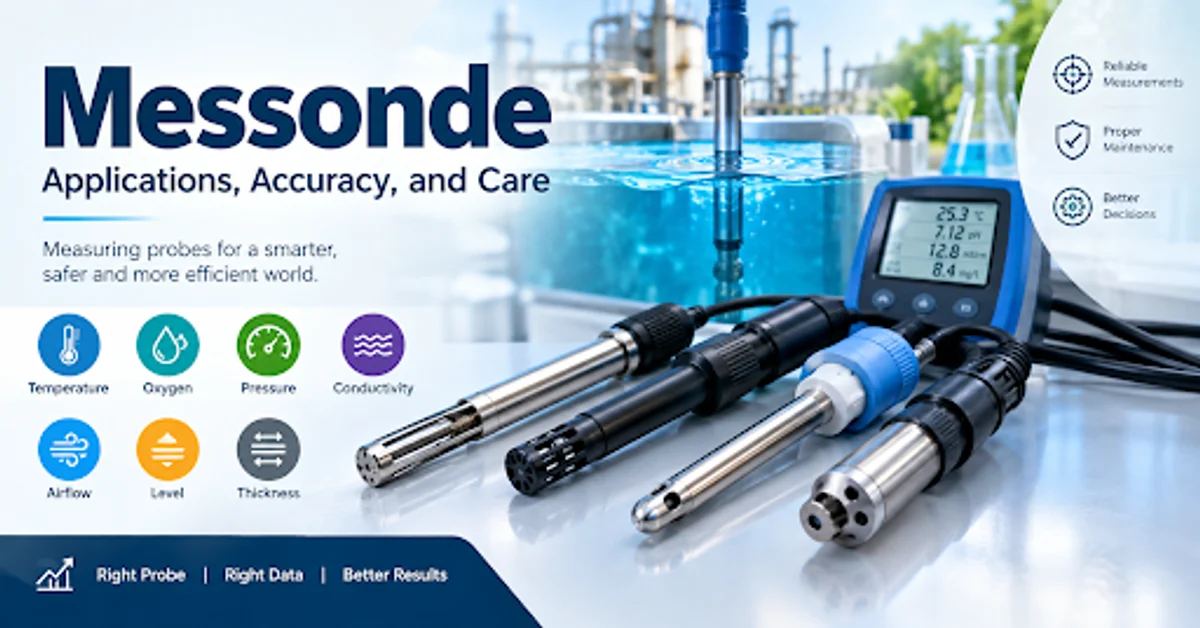
Messonde is an ambiguous term that, in technical contexts, often points toward Messsonde, the German term for a measuring probe. A measuring probe is a device or assembly designed to detect a particular physical or chemical property. Depending on its purpose, it may be placed in a liquid, inserted into a material, positioned in moving air, or attached to a surface.
For example, a temperature probe measures heat, while an oxygen probe can measure oxygen in water or gas. A pressure sensors measures pressure, and a conductivity probe measures how readily a liquid conducts electricity. These instruments provide information that helps users understand conditions, monitor processes, and make informed decisions.
Related: MathPlayzone: Fun Online Math Games for Kids
Why Messonde Has Different Meanings Online
The meaning of Messonde can be confusing because the exact spelling is less established in technical terminology than Messsonde. It may appear in translated documents, online articles, product descriptions, copied text, or searches involving German engineering terms. Some websites also use Messonde as a coined name associated with exploration, creativity, or personal development.
Other online descriptions present Messonde as a digital platform or technology. Such claims should be evaluated carefully because the name alone does not establish that a particular software product exists. Look for reliable documentation, identifiable developers, verified product information, and clear evidence before accepting these interpretations.
Messonde vs. Messsonde: Understanding the Difference
The German Technical Term Messsonde
Messsonde is the established German technical term associated with a measuring probe. German-English dictionaries, including LEO, translate it using terms such as measuring probe, test probe, and measuring sensor. The exact English translation depends on the instrument and its intended application.
A Messsonde may contain a sensing element, protective housing, cable, connector, and other components. Some designs are simple, while others incorporate electronic components or digital communication features. Its primary purpose is to obtain a measurement from a particular environment or material and provide information to a suitable instrument or control system.
Correct Spelling and Related Search Terms
When researching technical equipment, searching for Messsonde can produce more relevant information than searching for Messonde alone. The alternative spelling Meßsonde may also appear in older German documents, manuals, or scanned records. In modern German spelling, Messsonde is the form to prioritize.
Useful English search terms include measuring probe, measurement probe, sensing probe, sensor probe, and measuring sensor. Adding the specific property you need to measure can make research more accurate. For instance, searching for a temperature measuring probe or dissolved oxygen sensor is generally more useful than searching for Messonde without additional context.
How Does a Messonde Measuring Probe Work?
Sensing Elements and Measurement Signals
The working principle of a Messonde measuring probe depends on its sensing technology. At its center is a sensing element that responds to a change in the environment. This response may involve electrical resistance, voltage, current, light, mechanical movement, or a chemical interaction.
A thermocouple, for example, produces a voltage related to the temperature difference between its junctions. A Resistance Temperature Detector (RTD) measures temperature through a predictable change in electrical resistance, while a thermistor uses a temperature-sensitive resistor. Different technologies offer different measurement ranges, response times, and accuracy characteristics.
How Measuring Instruments Process Data
After the sensing element responds, the signal is transmitted to a measuring instrument, controller, or computer. The instrument processes the signal and converts it into a useful value, such as degrees Celsius, pressure, oxygen concentration, or airflow speed. Some systems also record measurements for later analysis.
This process is part of data acquisition, which involves collecting and organizing measurement information. Advanced systems may use digital sensors, transmitters, software, and automatic controls to monitor conditions continuously. In industrial automation, these measurements can help operators identify changes and maintain consistent production conditions.
Not every Messonde works independently. Some probes require a dedicated meter, compatible controller, or specific calibration settings. Physical connection alone does not guarantee that two devices will work together correctly.
Main Types of Messonde Measuring Probes
Temperature, Airflow, and Oxygen Probes
Temperature probes are widely used in food preparation, laboratories, storage facilities, manufacturing, and heating systems. Common technologies include thermocouples, RTDs, and thermistors. The appropriate option depends on the required temperature range, response time, accuracy, and operating environment. The National Institute of Standards and Technology (NIST) provides information about the calibration of these industrial thermometer technologies.
Airflow probes measure the movement of air and are commonly used in heating, ventilation, and air-conditioning (HVAC) systems. A vane probe uses a rotating element to help determine airflow speed, while other designs use thermal or pressure-based methods. An airflow meter may also help technicians assess ventilation performance.
Oxygen probes measure oxygen in gases or liquids. Dissolved oxygen sensors are particularly useful in water-quality monitoring, aquaculture, environmental studies, and laboratory testing. Different designs use electrochemical or optical methods, so a probe suitable for water is not automatically appropriate for hot industrial gases.
Conductivity, Level, and Thickness Probes
A conductivity probe measures electrical conductivity, which indicates how easily a liquid carries electrical current. Because dissolved ions influence conductivity, the measurement can help assess water conditions, monitor treatment processes, and estimate salinity when the appropriate method is used. Temperature compensation may be necessary because conductivity changes with temperature.
A level measurement probe detects or measures the amount of liquid or solid material in a container. Some devices detect whether a material has reached a specific point, while continuous level sensors track changing levels. Industrial applications may require equipment that can withstand pressure, heat, dust, foam, or corrosive substances.
Coating thickness probes measure layers such as paint, enamel, or protective coatings without necessarily removing them. Magnetic-inductive methods are suitable for certain coatings over ferrous metals, while eddy-current methods can measure suitable coatings over conductive, non-magnetic metals. The correct technology depends on both the coating and the underlying material.
Common Applications of Messonde
Industrial, Laboratory, and Manufacturing Uses
Industrial measuring probes support monitoring, process control, equipment maintenance, and quality control. Factories use temperature probes to monitor machinery, pressure sensors to check system conditions, and level sensors to track materials inside tanks. These measurements help operators identify unusual changes and maintain more consistent processes.
Laboratories also depend on measuring probes and laboratory instrumentation to collect reliable data. A pH meter measures how acidic or alkaline a solution is, while conductivity probes assess electrical conductivity. Temperature and pressure measurements support experiments in chemistry, materials science, and other research fields.
The value of a probe depends on selecting the right instrument for the task. A device designed for ordinary laboratory conditions may not withstand industrial pressure or corrosive chemicals. Reviewing specifications before use helps prevent unsuitable equipment choices and improves measurement reliability.
Environmental Monitoring and Food Safety
Environmental monitoring uses probes to assess conditions in air, water, soil, and other environments. Dissolved oxygen measurements, for example, help scientists evaluate aquatic conditions and investigate changes in water quality. Conductivity, temperature, pH, and other measurements can provide complementary information about a water sample.
The U.S. Geological Survey’s dissolved oxygen guidance explains measurement procedures, equipment selection, calibration, and troubleshooting for water-quality work. Reliable results depend on following the correct method and accounting for relevant environmental conditions.
In food production and preparation, temperature probes help users check internal food temperatures and monitor storage or processing conditions. Correct placement and appropriate cleaning are essential. A probe should be suitable for food contact and cleaned according to its manufacturer’s instructions to reduce contamination risks.
Messonde vs. Sensors and Measuring Instruments
Key Differences Between Probes and Sensors
A sensor detects a change in a physical or chemical property. A probe is often the physical assembly placed in or near the material being measured, and it may contain a sensor, protective housing, cable, and connector. A transducer is a device that converts one form of energy or signal into another; many sensing systems use transducers to produce measurable outputs.
These terms are related, but they are not always interchangeable. For example, a temperature probe may contain an RTD sensing element, while a separate digital meter displays the temperature. In another design, the probe may include electronics that process and transmit the measurement directly.
Understanding these distinctions helps buyers compare products more accurately. A listing described as a sensor may refer only to the sensing component, whereas a probe assembly may include the parts needed to position and connect it.
Understanding Measurement Systems and Equipment
A complete measurement system can include a probe, signal-conditioning electronics, a measuring instrument, data-acquisition software, and a controller. Each component has a specific role, from detecting a condition to displaying, recording, or acting on the result.
For example, an industrial temperature probe may send information to a controller that regulates a heating process. A water-monitoring system may record dissolved oxygen and temperature measurements over time. In both cases, useful results depend on the entire system rather than the probe alone.
Equipment compatibility matters when replacing an existing component. Connector type, signal format, measurement range, software requirements, and calibration settings should all be checked. A connector that physically fits does not necessarily establish electrical or functional compatibility.
Calibration, Accuracy, and Maintenance
How to Calibrate a Measuring Probe
Calibration compares a measuring device’s readings with a suitable reference under defined conditions. It helps establish how closely the instrument’s results agree with the reference and identifies measurement error. Depending on the device, calibration may involve a known temperature, a standard conductivity solution, or a prescribed oxygen-measurement procedure.
The method must match the probe. NIST describes comparison and fixed-point approaches for thermocouple calibration, while water-quality procedures may specify particular conditions for dissolved oxygen measurements. Follow the manufacturer’s instructions or an appropriate documented procedure rather than applying one calibration method to every sensor.
Calibration does not automatically repair a damaged probe, and adjustment is not always required. Keep records of calibration dates, reference materials, results, and any corrective work when traceability matters. Calibration frequency depends on the equipment, its use, required accuracy, and applicable quality procedures.
Cleaning, Troubleshooting, and Preventive Maintenance
Measuring probe maintenance helps preserve reliable performance. Dirt, grease, mineral deposits, dried salt, biological growth, and chemical contamination can interfere with a sensing surface. Clean the probe using only methods approved for its particular design, since aggressive chemicals or abrasive tools may damage electrodes, membranes, coatings, or protective materials.
Storage requirements also vary. Some laboratory probes need special storage conditions, while other instruments must be kept clean and dry. Check cables, connectors, seals, and protective housings regularly for wear or damage. Follow the manufacturer’s guidance for replacing membranes, maintaining electrodes, or servicing other sensitive components.
A maintenance log can help identify recurring issues and show when cleaning, calibration, or repair was completed. For critical industrial or laboratory measurements, use documented procedures and qualified technicians where appropriate.
How to Choose the Right Messonde
Measurement Range and Operating Conditions
Start by identifying exactly what needs to be measured: temperature, pressure, oxygen, airflow, conductivity, liquid level, or coating thickness. Then determine the expected measurement range and the accuracy required for the task. A probe that cannot cover the necessary range will not provide useful results, even if it measures the correct property in other conditions.
Consider the operating environment as well. High temperatures, pressure, moisture, vibration, corrosive chemicals, dust, and physical impact can affect probe performance. Probe length, diameter, mounting method, response time, and protective housing should also suit the application.
For water-quality monitoring, the material must be suitable for the water and its chemical conditions. For food applications, verify food-contact suitability. For coating measurements, confirm that the sensing method matches the surface and substrate.
Equipment Compatibility and Accuracy Requirements
Before buying a Messonde measuring probe, confirm that it works with the intended meter, controller, or data-acquisition system. Check the connector, output signal, supported sensor type, communication protocol, software requirements, and calibration procedure. These details are especially important when replacing a probe in an existing installation.
Compare more than the purchase price. Consider measurement accuracy, response time, durability, maintenance requirements, availability of replacement parts, and the cost of calibration. A less expensive probe may be unsuitable if it cannot withstand the environment or meet the required performance standards.
Consult the manufacturer’s technical documentation and ask a qualified supplier when specifications are unclear. Choosing equipment based on verified requirements is more dependable than relying on a product name or a general description alone.
Common Messonde Problems and Solutions
Incorrect Readings and Measurement Drift
Incorrect readings may result from poor probe placement, contamination, an unsuitable measurement range, calibration problems, or an incompatible instrument. Begin by checking the operating conditions and positioning, then inspect the sensing surface and compare the result with an appropriate reference when possible.
Measurement drift occurs when readings gradually change away from the expected value. It can be associated with sensor ageing, contamination, changing environmental conditions, or deterioration of the sensing element. Cleaning and recalibration may help, but persistent drift can indicate a need for servicing or replacement.
Do not assume every unusual reading means the probe is defective. The meter, cable, process conditions, and measurement method can also affect results. Follow a documented troubleshooting procedure, especially when the measurement influences safety or product quality.
Damaged Cables, Contamination, and Compatibility Issues
Damaged cables, loose connectors, moisture ingress, and worn seals can cause unstable readings or complete signal loss. Inspect accessible parts for visible damage and confirm that connections are secure according to the manufacturer’s instructions. Do not use damaged equipment in conditions for which it is no longer rated.
Contamination can also affect accuracy, particularly in conductivity, pH, oxygen, and other probes that interact directly with liquids. Clean the device using an approved procedure and verify its performance afterward. Never scrape a sensitive surface or apply an unapproved chemical simply to remove stubborn deposits.
Finally, confirm equipment compatibility whenever a probe is replaced or connected to a different instrument. If readings remain unreliable after basic checks, consult the manufacturer or a qualified technician rather than making unsupported adjustments.
Related: SparkPressFusion Com: Complete Website Guide
Frequently Asked Questions
What Is Messonde?
Messonde is a term often associated with the German word Messsonde, meaning a measuring probe. These probes detect physical or chemical properties such as temperature, pressure, oxygen, and conductivity.
What Is the Difference Between Messonde and Messsonde?
Messsonde is the established German technical spelling for a measuring probe. Messonde may appear as a spelling variation, a typing error, or a separate name used online.
How Does a Messonde Measuring Probe Work?
A Messonde measuring probe uses a sensing element to detect changes in its surroundings. It converts those changes into signals that a compatible measuring instrument can process and display as useful readings.
What Are the Common Uses of Messonde?
Measuring probes are used in laboratories, manufacturing, HVAC systems, food safety, water treatment, and environmental monitoring. Their applications depend on the type of probe and the property being measured.
Does a Messonde Measuring Probe Require Calibration?
Yes, many measuring probes require periodic calibration or verification to maintain reliable results. The appropriate method and frequency depend on the probe type, manufacturer recommendations, operating conditions, and required measurement accuracy.
Summary
Messonde is best approached as a context-dependent term, with its strongest technical connection being the German word Messsonde, meaning a measuring probe. These probes play an important role in industrial automation, laboratory testing, HVAC systems, food safety, water treatment, manufacturing, and environmental monitoring. Different designs measure different properties, so no single probe can perform every measurement.
Choosing the right equipment requires attention to measurement range, accuracy, operating conditions, compatibility, and maintenance needs. Regular inspection, appropriate cleaning, and suitable calibration procedures help maintain dependable results. When researching Messonde, prioritize reliable technical dictionaries, manufacturer documentation, scientific guidance, and verified specifications. This approach provides a clearer understanding of the term and helps readers make informed decisions about measuring technology.