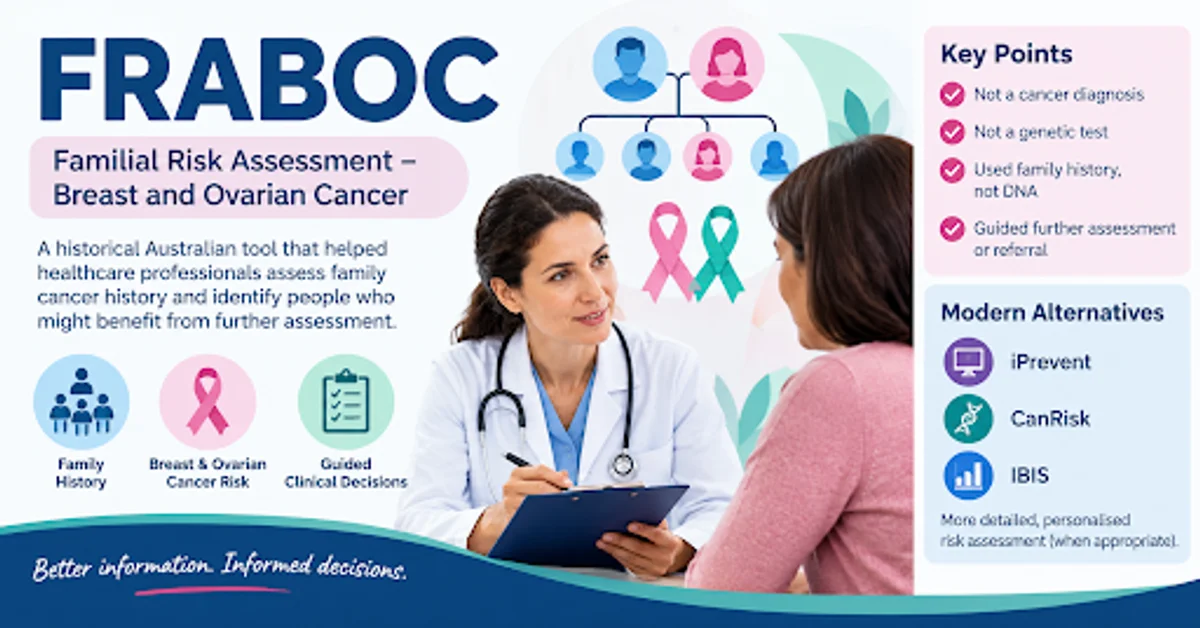
The FRABOC full form is Familial Risk Assessment – Breast and Ovarian Cancer. It was an Australian clinical risk assessment tool designed to help healthcare professionals understand whether a person’s family history suggested an increased likelihood of breast or ovarian cancer.
The FRA-BOC tool focused on patterns of cancer among relatives. It helped organize relevant information into broad risk categories, supporting decisions about whether additional assessment or referral might be appropriate.
FRABOC did not diagnose cancer, examine body tissue, or analyze DNA. Instead, it used family medical history to support a health professional’s assessment of possible inherited cancer risk.
Family cancer history can be complicated. A person may have several relatives with different cancers, and the ages at diagnosis can significantly affect how a healthcare professional interprets that history. A structured tool such as FRABOC helped make this information easier to assess consistently.
The historical tool was associated with Cancer Australiathe Australian government’s cancer control agency. It supported clinical discussions about familial breast and ovarian cancer risk, helping practitioners identify people who might benefit from more detailed assessment.
Related: Tracqueur: The Smart, Simple Way to Track What Matters
What Was FRABOC Used For?
Assessing Breast and Ovarian Cancer Risk
Fraboc cancer risk assessment helped healthcare professionals evaluate whether a woman’s family history indicated average, moderately increased, or potentially high breast cancer risk. It also supported consideration of ovarian cancer patterns within the family.
These categories were intended to guide further assessment rather than predict an individual’s future with certainty. A higher-risk classification did not mean that someone had cancer or would definitely develop it.
FRABOC was a decision-support tool, not a screening test. Mammography, diagnostic imaging, and laboratory tests serve different purposes and should be considered according to current medical advice.
Understanding Family Cancer History
Family history is an important part of assessing inherited cancer risk. Healthcare professionals consider which relatives developed cancer, the type of cancer, their ages at diagnosis, and whether several cases occurred on the same side of the family.
For example, breast cancer diagnosed at a young age or a family history involving both breast and ovarian cancer may warrant closer assessment. Male breast cancer and cancer affecting both breasts can also be relevant clues.
However, these patterns do not automatically establish a hereditary cancer syndrome. A qualified professional must consider the complete family history and other personal cancer risk factors before recommending further action.
How Did the FRABOC Tool Work?
Information Required for Family Risk Assessment
FRABOC relied mainly on information about cancer among biological relatives. A health professional would gather details about affected family members, their relationships to the person being assessed, the cancers they had, and their approximate ages when diagnosed.
This information helped reveal family cancer patterns that might otherwise be difficult to recognize. A history involving several relatives with relevant cancers could be more significant than an isolated case, although the exact interpretation depended on the circumstances.
A Fraboc family history assessment was only as informative as the details available. Missing or uncertain information could limit its usefulness, so practitioners needed to interpret results carefully rather than treat them as definitive.
The Role of First-Degree and Second-Degree Relatives
First-degree relatives include parents, siblings, and children. Second-degree relatives include grandparents, aunts, uncles, nieces, and nephews. Their cancer histories can help professionals identify patterns that may suggest an inherited predisposition.
Both the mother’s and father’s sides of the family matter. Cancer-related gene changes can be inherited from either parent, so a family history should not focus exclusively on maternal relatives.
The number of affected relatives is only one part of the assessment. Cancer type, age at diagnosis, relationships between affected family members, and any known genetic test results can all influence a modern risk evaluation.
What Were the FRABOC Risk Categories?
Average, Slightly Increased, and Moderate Risk
The historical FRABOC risk categories included an at-or-slightly-above-average group, a moderately increased-risk group, and a potentially high-risk group. These classifications helped healthcare professionals determine whether further assessment might be necessary.
Older guidance described the lowest category as representing more than 95% of women, with an estimated breast cancer risk by age 75 of approximately one in eleven to one in eight. The moderately increased-risk group was described as fewer than 4% of women, with an estimated risk of approximately one in eight to one in four.
These figures are historical estimates, not current personal predictions. They should not be used to calculate your own breast cancer risk, and they may not apply to every individual or population.
Potentially High Breast Cancer Risk
The potentially high-risk category was intended to identify family histories that might require specialist assessment. Older guidance described this group as fewer than 1% of women, with an estimated breast cancer risk by age 75 of approximately one in four to one in two.
Possible warning patterns included multiple relatives with breast cancer on the same side of the family, breast cancer at a young age, cancer in both breasts, male breast cancer, or a combination of breast and ovarian cancer. A known high-risk genetic variant could also be important.
These signs do not prove that a person carries an inherited gene change. A current high-risk cancer assessment should use appropriate clinical guidance and validated methods rather than relying on historical FRABOC categories.
How Did FRABOC Assess Ovarian Cancer Risk?
Family Patterns Associated With Ovarian Cancer
FRABOC also helped practitioners consider ovarian cancer within a family’s medical history. Several relatives with ovarian cancer, particularly alongside early-onset breast cancer or other relevant cancers, could indicate a need for closer evaluation.
Hereditary breast and ovarian cancer can be associated with inherited changes in genes such as BRCA1 and BRCA2. Nevertheless, most family histories involving cancer do not automatically establish a hereditary condition, and individual cases require careful interpretation.
The tool helped identify patterns worth investigating, but it could not confirm an inherited mutation or diagnose ovarian cancer. Genetic counselling and specialist assessment may be appropriate when family history suggests a possible inherited risk.
When Further Medical Assessment Was Needed
A healthcare professional might consider a clinical referral when the family history suggested an increased risk. Depending on the circumstances, the next step could involve a family cancer clinic, a more detailed risk assessment, or genetic counselling.
Ovarian cancer screening requires particular care. Tests such as CA125 blood testing and transvaginal ultrasound are not reliable universal screening methods for average-risk, asymptomatic people. Their use depends on clinical circumstances and current guidance.
Anyone concerned about ovarian cancer symptoms or family history should discuss the situation with a healthcare professional rather than use old FRABOC guidance to decide whether screening is necessary.
FRABOC vs. BRCA Genetic Testing
Key Differences Between Family History and DNA Testing
FRABOC and BRCA genetic testing served different purposes. FRABOC assessed family cancer patterns, whereas genetic testing examines DNA to identify particular inherited genetic variants.
A family history assessment can help a practitioner decide whether genetic counselling or testing may be appropriate. However, it cannot establish whether someone carries a specific gene change.
Similarly, a negative genetic test does not always eliminate inherited cancer risk. Results must be interpreted in context, including the person’s family history and the type of test performed.
Understanding BRCA1 and BRCA2 Gene Changes
BRCA1 and BRCA2 are genes involved in DNA repair. Certain harmful inherited variants in these genes can increase the risk of breast, ovarian, and some other cancers.
A family history involving early-onset breast cancer, ovarian cancer, male breast cancer, or multiple related cancer cases may prompt a clinician to consider genetic counselling. A genetic counsellor can explain the benefits, limitations, and possible implications of testing.
Not everyone with a family history of cancer has a BRCA1 or BRCA2 variant, and not every carrier develops cancer. Decisions about testing and risk management should be individualized with qualified healthcare professionals.
Is FRABOC Still Available Today?
Why the Original FRABOC Tool Was Discontinued
The original FRABOC tool is no longer available through Cancer Australia. People searching for a working Fraboc calculator may therefore encounter older documents or references instead of an active assessment service.
Its absence does not mean that family cancer risk assessment is no longer available. Modern tools and clinical pathways provide ways to evaluate family history and other risk factors using updated models and current professional guidance.
Because clinical practice evolves, historical categories should be understood in their original context. For current decisions, practitioners should follow applicable guidelines and use tools appropriate to the person’s circumstances.
Why FRABOC Still Appears in Medical Records
FRABOC may still appear in older general practitioner (GP) notes, referral letters, medical PDFs, and cancer information pages. In an Australian medical context, the name usually refers to Familial Risk Assessment – Breast and Ovarian Cancer.
If you find FRABOC in a document, the reference may describe an assessment performed under an older system. It does not necessarily indicate that the tool was used recently or that you have a particular level of cancer risk.
Ask your GP to explain the entry if its meaning is unclear. They can review the date, the context, and any recorded recommendations to determine whether a current assessment is needed.
What Replaced FRABOC?
Understanding iPrevent, CanRisk, and IBIS
Several modern breast cancer risk assessment tools are available, including iPrevent, CanRisk, and IBIS. They are not direct copies of FRABOC; they use established risk models and may incorporate a broader range of information.
iPrevent was developed by a team at Peter MacCallum Cancer Centre. It helps assess breast cancer risk and supports discussions about risk management. Depending on the assessment, relevant information may include family history, personal health factors, and reproductive history.
CanRisk is an online tool based on the BOADICEA risk model. IBIS, also known as the Tyrer-Cuzick model, estimates breast cancer risk using family history and other factors. Suitability and access may vary, and interpretation should follow the tool’s intended clinical use.
How Modern Cancer Risk Assessment Tools Differ
The main difference between FRABOC and modern cancer risk prediction models is the level and type of information they can incorporate. FRABOC used broad historical categories, while modern models can generate more individualized estimates when sufficient information is available.
The appropriate tool depends on the person’s circumstances, the quality of the available information, and the clinical question. No model can predict with certainty whether an individual will develop cancer.
How to Prepare for a Family Cancer Risk Assessment
Collecting Family Medical History and Genetic Test Results
Before a medical appointment, try to collect information about relatives who had cancer. Record their relationship to you, the cancer type, their age at diagnosis, and whether the cancer affected one or both breasts.
Include relatives on both sides of the family. If a family member had genetic testing, bring the report if it is available. A documented result can be more useful than a general recollection that someone tested positive or negative.
Do not worry if you cannot obtain every detail. Share what you know and identify anything uncertain. Your GP or specialist can help determine whether additional information would improve the assessment.
Questions to Discuss With a Healthcare Professional
Ask whether your family history suggests average, increased, or potentially high risk under current assessment guidance. You can also ask whether a validated risk model, genetic counselling, or referral to a familial cancer clinic would be appropriate.
Depending on your circumstances, a clinician may discuss mammography, other breast cancer screening options, genetic testing, or risk management strategies. Recommendations depend on factors such as age, personal history, family patterns, and current local guidelines.
BreastScreen Australia provides information about Australia’s national breast screening program. Eligibility, screening intervals, and the best next step depend on individual circumstances; people with a strong family history may need advice beyond routine population screening.
Related: Thealitekeepsafe.com: A Complete Website Guide
Frequently Asked Questions
What does FRABOC stand for?
FRABOC stands for Familial Risk Assessment – Breast and Ovarian Cancer. It was a historical Australian tool for assessing cancer risk patterns based on family history.
Is FRABOC still available?
No. The original FRABOC tool is no longer available through Cancer Australia. Modern risk assessment options include iPrevent, CanRisk, and IBIS.
Was FRABOC a genetic test?
No. FRABOC used family history rather than DNA analysis. Genetic testing examines DNA for specific variants that may influence cancer risk.
What replaced FRABOC?
There is no single direct replacement for every use of FRABOC. Modern options include iPrevent, CanRisk, and IBIS, selected according to clinical needs and the information available.
Summary
FRABOC stands for Familial Risk Assessment – Breast and Ovarian Cancer. It was an Australian tool that helped healthcare professionals evaluate family cancer history and identify people who might benefit from further assessment.
It was not a cancer diagnosis, genetic test, or guarantee of future health. Its historical risk categories helped guide clinical decisions, but they should not be used to estimate personal cancer risk today.
If you have encountered FRABOC in an old medical record, your GP can explain what it meant at the time and whether a new assessment would be useful. Current tools such as iPrevent, CanRisk, and IBIS may support a more detailed evaluation when appropriate.
Reliable cancer risk management begins with accurate family information, clear communication, and professional guidance. Understanding FRABOC can help you interpret older records and take a well-informed next step.