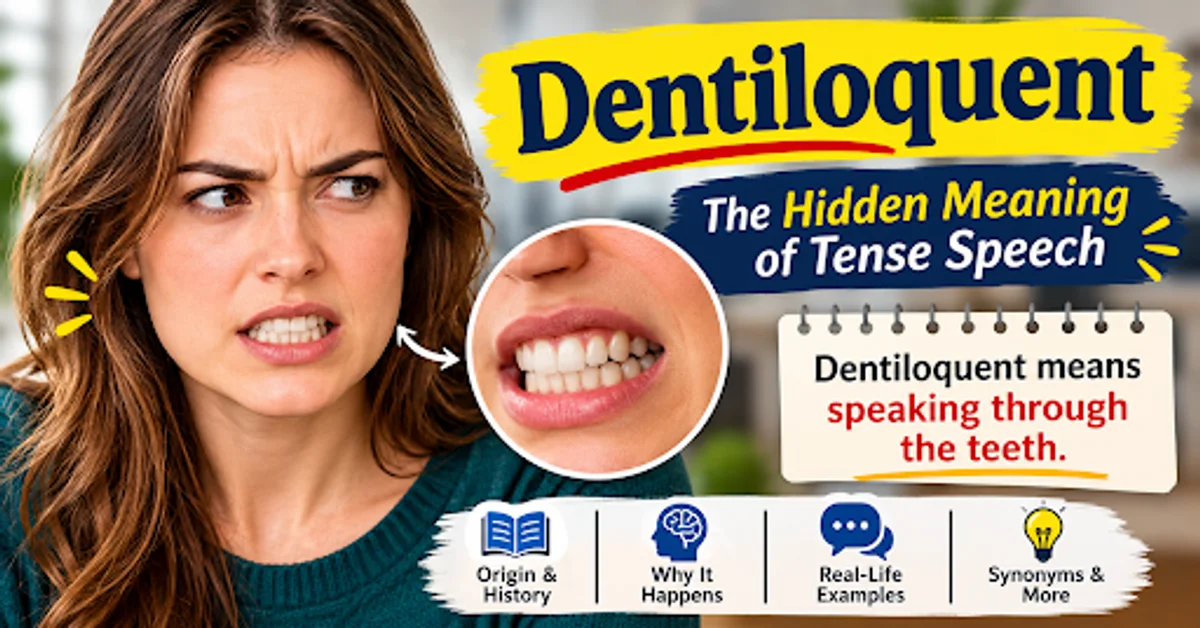
Dentiloquent is used to describe someone who speaks through their teeth or keeps their teeth close together while talking. It is an adjective used to describe a particular manner of speaking rather than a person’s personality or permanent communication style.
In simple English, dentiloquent means speaking with a restricted mouth opening, often producing a tight or tense sound. The expression can be associated with frustration, emotional pressure, or an effort to remain composed. However, the word itself does not identify the exact emotion behind the speaker’s voice.
Speaking through clenched teeth is a familiar example of dentiloquent speech. Instead of opening the mouth naturally, a person keeps the jaw relatively tight and allows words to pass through a smaller opening. The result may sound sharp, restrained, or slightly muffled.
For example, someone might say, “Please leave me alone,” without raising their voice but with noticeable tension in their jaw. Their words remain understandable, yet their delivery communicates a different feeling from ordinary conversation. This distinction makes dentiloquent a useful word for describing subtle differences in verbal communication.
Related: Wenrath: Population, Business, and Local History
Origin and History of the Word Dentiloquent
Latin Roots Behind Dentiloquent
The dentiloquent word’s origin is connected to Latin vocabulary. Two useful Latin roots help explain the construction: dens, meaning tooth, and loqui, meaning to speak. These roots also appear in other English words associated with teeth and speech.
The related noun dentiloquy refers to the act or practice of speaking through the teeth or with the teeth closed. The ending -loquy appears in words associated with speaking, including soliloquy and colloquy. Similarly, loquacious describes someone who talks a great deal, while eloquent describes someone who expresses ideas effectively.
Etymology, Origin & Meaning
Historical Usage and Development
Dentiloquent is an unusual term, and its history should be approached carefully. The related word dentiloquy is recorded in historical word-origin research from 1737. Its Latin components help explain why the expression describes speech produced with the teeth closed or held together.
Etymology, Origin & Meaning
Historical dictionaries also provide an interesting background to rare English vocabulary. Thomas Blount published Glossographia in 1656, an important work that explained difficult words and included etymological information. However, its historical importance does not establish that dentiloquent itself appeared in that edition. Modern readers may also encounter the term through Collins English Dictionary’s New Word Suggestion section, where dentiloquent is described as talking through one’s teeth and is marked as being monitored for evidence of usage.
How Dentiloquent Speech Sounds
Common Characteristics of Dentiloquent Speech
Dentiloquent speech often has a recognizable sound. The speaker may produce words with limited mouth movement, a tight jaw, and a controlled expression. Their voice can seem sharp, clipped, quiet, or tense, depending on the situation.
Some speakers may sound as though they are trying to prevent their emotions from becoming obvious. Others may simply have a naturally restricted speaking style at a particular moment. Dentiloquent speech is not necessarily loud or aggressive. It can be soft and controlled while still sounding emotionally charged.
The Role of Teeth, Jaw, and Voice
The teeth and jaw play important roles in producing speech sounds. Normal conversation involves coordinated movement of the tongue, lips, jaw, and other speech structures. When the jaw is held tightly, the usual movement and opening of the mouth may become restricted.
This restriction can influence pronunciation and clarity. Some words may sound less distinct, while the speaker’s voice may seem different from their usual speech patterns. The combination of clenched teeth, limited jaw movement, and a tense voice helps create the impression associated with dentiloquent communication.
Why Do People Speak in a Dentiloquent Way?
Emotional Reasons Behind Tense Speech
People sometimes speak through their teeth when they are experiencing strong emotions but do not want to express them openly. They may be frustrated, disappointed, embarrassed, or uncomfortable with a particular situation. Instead of responding loudly, they keep their words short and their voices controlled.
This behavior can occur when someone wants to maintain politeness or avoid making a disagreement worse. For example, an employee might respond calmly to an unfair comment while feeling upset internally. Their speech may become restrained because they are concentrating on choosing appropriate words.
Anger, Stress, Fear, and Suppressed Feelings
Anger is one possible reason for dentiloquent speech, but it is not the only explanation. Stress, fear, sadness, embarrassment, and emotional exhaustion can also influence how someone speaks. A person may keep their jaw tight because they are concentrating, feeling uncomfortable, or trying to manage a difficult conversation.
It is important not to assume that every person speaking through clenched teeth is angry. Voice and facial expressions provide useful context, but they cannot reveal someone’s feelings with certainty. Asking a gentle question is often more helpful than making an immediate judgment.
Common Situations Where Dentiloquent Speech Occurs
Dentiloquent Speech in Family and Social Life
Family conversations can involve many emotions, including happiness, disappointment, concern, and frustration. A parent might use a tight voice when reminding a child about an important responsibility. Similarly, a child might respond through their teeth when feeling embarrassed or misunderstood.
Social situations can produce similar reactions. Someone attending a family gathering may want to remain respectful even when a comment makes them uncomfortable. Their words might sound polite, but their facial expressions and tone could suggest tension. These situations demonstrate how communication involves more than the words being spoken.
Dentiloquent Speech at School and Work
Schools and workplaces require people to communicate with different personalities and manage challenging situations. A student may speak in a restrained voice after receiving criticism in front of classmates. A teacher might also use a firm, controlled tone while addressing repeated interruptions.
At work, an employee may feel frustrated during a difficult meeting but still choose professional language. A manager might deliver a short response while trying to maintain control of a stressful discussion. Dentiloquent speech can describe these moments, although it should not be treated as proof of someone’s attitude or intentions.
The Connection Between Dentiloquent Speech and Body Language
Facial Expressions and Jaw Tension
Facial expressions can add meaning to spoken words. A tight jaw, pressed lips, narrowed eyes, and limited facial movement may create an impression of emotional tension. When these features appear alongside speaking through the teeth, they can make a person’s communication seem particularly restrained.
However, facial expressions are not universal emotional signals. Different people express themselves in different ways, and a tight jaw may have several explanations. Dentiloquent is therefore most useful as a description of speech, while facial expressions provide additional context for understanding the situation.
How Tone and Posture Communicate Hidden Emotions
A person’s posture and voice can influence how listeners interpret a conversation. Someone who speaks quietly with stiff shoulders may appear uncomfortable, while another person may use a low-pitched voice to communicate seriousness. These details contribute to nonverbal communication.
Tone, posture, breathing, and facial movement should be considered together rather than separately. A simple statement such as “That is fine” can communicate different meanings depending on how it is delivered. Dentiloquent speech highlights this connection between verbal communication and physical expression.
Dentiloquent Examples in Everyday Language
Common Sentences Using Dentiloquent
Understanding dentiloquent examples makes the word easier to remember and use. Since it is an adjective, it can describe a voice, response, remark, or manner of speaking.
Here are some natural examples:
- She gave a dentiloquent reply during the disagreement.
- His dentiloquent voice revealed his frustration.
- The teacher responded in a controlled, dentiloquent tone.
- He delivered a dentiloquent warning without raising his voice.
- Her dentiloquent words sounded polite but tense.
- The character spoke in a dentiloquent manner throughout the scene.
These examples demonstrate how the word can describe speech without requiring a long explanation of the speaker’s physical expression.
Dentiloquent Speech in Real-Life Conversations
Imagine two colleagues discussing an unfinished project. One asks, “Have you completed the report?” The other replies, “I am working on it.” If the response comes through tightly held teeth, it may sound different from an ordinary answer.
Another example could involve a family conversation. Someone says, “I understand what you are saying,” but delivers the sentence with a stiff jaw and a tense voice. The words appear reasonable, yet the delivery suggests discomfort. These examples show why dentiloquent is useful when describing the relationship between spoken language and emotional expression.
Dentiloquent Synonyms and Related Words
Words Similar to Dentiloquent
Finding dentiloquent synonyms requires understanding that very few words have exactly the same meaning. Expressions such as speaking through clenched teeth, speaking tensely, and delivering a restrained response can communicate a similar idea.
Other related vocabulary includes clipped speech, tight-lipped communication, muffled speech, and restrained speech. These expressions describe different aspects of the behavior, but they are not perfect replacements. Dentiloquent is more specific because it focuses on speaking through or with the teeth held together
.
How Writers Can Use Dentiloquent
Using Dentiloquent to Describe Characters
Dentiloquent is particularly useful in creative writing because it gives readers a specific picture of how a character speaks. Instead of simply writing that someone is frustrated, an author can describe their tightly controlled voice and limited mouth movement.
The word can suit many types of characters, including parents, teachers, students, managers, friends, and fictional heroes. It can also help portray a character who wants to remain composed during an uncomfortable situation. This makes dentiloquent a valuable addition to descriptive vocabulary.
Creating Realistic Dialogue and Emotional Scenes
Good dialogue does more than communicate information. It helps readers understand relationships, personalities, and emotional changes. A dentiloquent response can make a conversation feel more realistic because it shows how a character delivers words rather than focusing only on what they say.
For example, an author might write, “I have already explained everything,” he replied dentiloquently. This short sentence gives readers a clearer impression of the character’s delivery. It can create tension without requiring dramatic shouting or lengthy descriptions.
Why Understanding Dentiloquent Matters
Recognizing Hidden Feelings Through Speech
Learning rare words such as dentiloquent makes everyday communication easier to describe. It gives readers a specific term for a familiar speaking style and encourages them to notice the relationship between voice, facial expressions, and physical movement.
It also reminds us that people do not always express their feelings directly. Someone may choose careful words while sounding uncomfortable or frustrated. Recognizing this possibility can encourage more thoughtful conversations, although it is important to ask rather than assume what another person feels.
Responding to Tense Communication with Understanding
When someone speaks through their teeth, responding with patience can help prevent unnecessary misunderstandings. A calm voice, respectful language, and willingness to listen can make a difficult conversation more comfortable.
Sometimes, taking a short pause is more useful than continuing an argument. Allowing someone to explain their concerns can improve communication and build mutual understanding. Dentiloquent speech reminds us that listening involves paying attention to both words and the way they are delivered.
Related: Mietmakler: Complete Guide to Rental Brokers in Germany
Frequently Asked Questions
What Does Dentiloquent Mean in Simple English?
Dentiloquent means speaking through the teeth or talking while keeping the teeth close together. It describes a particular way of speaking that may sound tight, controlled, or slightly muffled.
Is Dentiloquent a Real English Word?
Yes. Dentiloquent appears in Collins English Dictionary’s New Word Suggestion section. However, Collins identifies it as a suggested word being monitored for evidence of usage rather than an established standard dictionary entry. It remains an extremely rare expression.
What Is the Origin of Dentiloquent?
The word is built around Latin roots associated with teeth and speaking. The related term dentiloquy combines Latin dens, meaning tooth, with loqui, meaning to speak. The related noun has been traced to 1737.
What Are Some Examples of Dentiloquent Speech?
Examples include speaking through clenched teeth during an argument, giving a tense response during a difficult meeting, or delivering a controlled reply while feeling frustrated. The defining feature is the manner of speaking, not necessarily the emotion behind it.
What Is the Difference Between Dentiloquent and Mumbling?
Dentiloquent describes speaking through the teeth, whereas mumbling means speaking unclearly or indistinctly. Someone can mumble without keeping their teeth together, and someone can speak dentiloquently while still making their words understandable.
Summary
Dentiloquent is a fascinating and uncommon English word that describes a familiar human behavior: speaking through tightly held teeth. Its meaning goes beyond ordinary speech descriptions by highlighting the relationship between mouth movement, voice, and communication. From family conversations and workplace discussions to creative writing and everyday vocabulary, dentiloquent offers a precise way to describe a particular speaking style. Its Latin connections through dens and loqui also make it an interesting word for language enthusiasts.
Although dentiloquent speech can sometimes accompany anger, stress, sadness, or emotional pressure, it does not always reveal exactly what someone is feeling. Context and individual differences matter. Understanding this distinction helps us become more thoughtful communicators and better listeners. Ultimately, learning dentiloquent adds another useful expression to our vocabulary. It reminds us that communication is not only about choosing the right words but also about how those words are spoken.