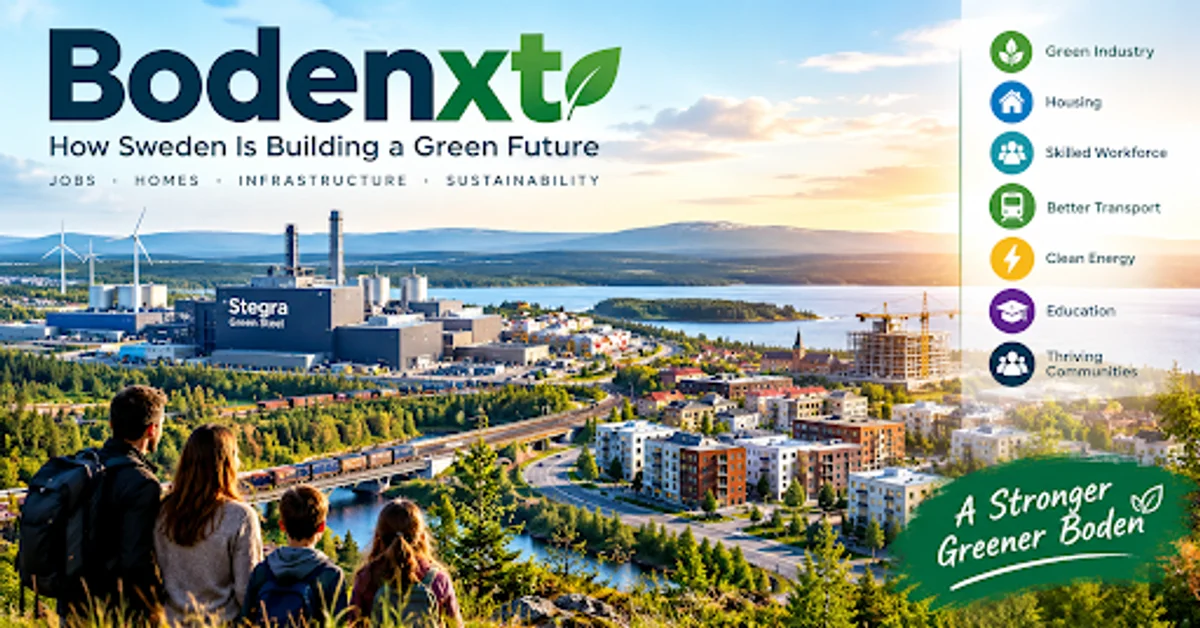
Bodenxt is a development platform associated with Boden Municipality in Norrbotten County, Sweden. It brings together different aspects of municipal development to help the area respond to major industrial investment and population change. Rather than representing one factory or construction project, it covers the wider conditions required for a growing town to thrive.
The central idea behind Bodenxt is coordinated planning. Industrial investment can create employment quickly, but sustainable growth also requires homes, transport, electricity, water, schools, and accessible public services. Connecting these needs helps the municipality prepare for change more effectively.
Boden Municipality must balance immediate development needs with the long-term interests of residents. Bodenxt supports this broader perspective by connecting industrial development with housing, workforce planning, business opportunities, and community services.
The scale of the transformation has been described as accomplishing roughly 20 years of development within a few years. This illustrates the pressure on local planning systems. Successful municipal development planning must anticipate demand, coordinate investments, and ensure that growth benefits existing residents as well as newcomers.
Related: Wattios: How to Reduce Electricity Bills
How Bodenxt Is Connected to Stegra
The Difference Between Bodenxt and Stegra
Bodenxt and Stegra are closely connected, but they serve different purposes. Bodenxt concerns the wider development of Boden, while Stegra is a private industrial company developing a green steel facility in the area. Stegra was previously known as H2 Green Steel.
This distinction matters because Boden’s transformation depends on more than the progress of one company. Industrial growth can stimulate suppliers, construction businesses, transport services, and local shops, while also increasing demand for housing and public infrastructure. Bodenxt addresses these wider community needs.
Stegra’s Green Steel Project in Boden
Stegra’s project at Boden Industrial Park aims to combine hydrogen-based iron production with steelmaking. The planned production process is designed to reduce reliance on coal and lower emissions compared with conventional steelmaking routes. The project has attracted attention because of its potential role in the industrial transition toward lower-carbon production.
Stegra has reported a potential reduction in carbon dioxide emissions of up to 95% compared with traditional coke-fired blast-furnace steelmaking. This is a company-reported target, not a verified result from full commercial production. Construction schedules, financing, commissioning, and future operating performance remain important factors when assessing the project’s progress.
Why Boden Is Becoming a Green Industry Hub
The Role of Fossil-Free Electricity and Green Hydrogen
Green steel production depends on access to substantial amounts of energy. In hydrogen-based steelmaking, hydrogen can replace coal-derived materials in important stages of iron production. When produced using low-emission electricity, green hydrogen can help reduce the carbon emissions associated with conventional steelmaking.
Fossil-free electricity is therefore an important advantage for industrial projects in northern Sweden. However, the environmental benefits depend on the energy sources, production methods, infrastructure, and emissions across the entire industrial process. Reliable power supplies are also essential because large factories, homes, and public services will compete for electricity as demand increases.
Northern Sweden’s Industrial Advantages
Boden benefits from its location in northern Sweden, where established mining, energy, and industrial activities provide relevant skills and business experience. Available industrial land and connections to wider transport networks can also support major investments.
These advantages help explain the region’s green industry ambitions, but natural resources alone do not guarantee success. Sustainable industrial development also requires trained workers, reliable utilities, suitable housing, effective logistics, and cooperation between public authorities and private companies.
Bodenxt Jobs, Skills, and Workforce Development
Expected Employment Opportunities in Boden
Boden’s industrial expansion could generate employment in engineering, construction, manufacturing, maintenance, logistics, and technical services. Municipal projections cited in the supplied material estimate around 10,000 direct and indirect jobs across the wider region, including roughly 2,000 connected with Stegra. These are projections, not a count of permanent jobs already created.
Employment opportunities may also grow in retail, hospitality, education, healthcare, property management, and other local services. As workers and families move into the area, businesses will need additional employees to serve the expanding population. The scale of these benefits will depend on actual investment, project delivery, and long-term demand.
Technical Education and Local Skills Training
Workforce development is essential if Boden wants industrial investment to create lasting opportunities for local people. Technical education, apprenticeships, workplace learning, and professional training can help residents prepare for emerging jobs while supporting employers seeking skilled workers in Sweden.
The supplied information identifies a technical programme at Björknäsgymnasiet scheduled to begin in autumn 2026, with links to industrial design, product development, and workplace learning. Stegra, SMS Group Nordic, local industry, and the Swedish Armed Forces have been involved in connecting education with practical skills needs. Its implementation and outcomes should be assessed as the programme develops.
Housing and Population Growth in Boden
Housing Demand and Challenges for New Residents
Boden’s housing supply is a major factor in determining whether industrial growth translates into permanent population growth. According to the supplied figures, the municipality ended 2025 with 28,624 registered residents, exceeding an earlier forecast. Temporary workers may increase the number of people living in the area beyond the registered population.
Development plans have reportedly enabled around 1,300 apartments, yet rental availability remained extremely limited in municipal reporting from May 2026. A housing shortage in Boden can make recruitment harder, limit choices for young adults and families, and increase pressure on existing residents. Planning enough homes in different sizes and price ranges is therefore vital.
Relocation Services and Community Development
Municipal relocation services can help new workers and their families navigate the practical challenges of moving. Finding accommodation, understanding local services, locating schools, arranging childcare, and learning about the community can make settling in Boden easier.
The supplied material reports that by late 2025, approximately 275 Stegra employees were living in Boden, representing an estimated 640 residents when accompanying adults and children were included. These figures illustrate how employment-related relocation can affect population growth. Long-term success, however, depends on whether newcomers find suitable homes, meaningful community connections, and reliable everyday services.
Infrastructure and Transportation Development
Railway Connections, Roads, and Local Transport
Reliable transport is essential for moving industrial materials, delivering products, and connecting employees with workplaces. According to the supplied information, a railway connection serving Boden Industrial Park has been completed. It includes approximately six kilometres of track and nine bridges and accommodates trains up to 1,000 metres long.
The connection links the industrial park with the Swedish rail network, improving freight possibilities for Stegra and other businesses. Road improvements and local travel routes also matter because industrial growth increases daily movement between homes, workplaces, and services. Walking and cycling connections can make these changes more useful for residents, not just factories.
Water, Wastewater, Electricity, and Digital Infrastructure
Some of Bodenxt’s most important work involves infrastructure that residents rarely see. Water and wastewater systems, drainage, electricity networks, and digital connections must support both industrial facilities and new residential areas. Insufficient capacity in any of these systems can delay construction or reduce service reliability.
Planning ahead helps the municipality coordinate new developments with utility capacity. Electricity demand deserves particular attention because hydrogen production and steelmaking can require large amounts of power. Effective infrastructure planning must balance industrial requirements with the everyday needs of households, schools, businesses, and other public services.
Bodenxt and Sustainable Business Growth
Business Opportunities Beyond Stegra
Stegra is a major driver of investment, but a resilient local economy needs a diverse range of employers. Industrial supply chains can create opportunities for engineering firms, construction contractors, maintenance providers, transport operators, technology companies, and other service businesses.
The supplied material reports that 38 new companies had established themselves in Boden by June 2025 after Stegra announced its investment. This figure indicates reported business activity, although it does not establish that every company was directly connected to Stegra. Local business development can strengthen Boden’s economic base if new firms build lasting operations and recruit workers across different sectors.
Boden Plug & Play and Circular Industry
Boden Plug & Play is described as an area of approximately 70 hectares intended for sustainable businesses and circular industrial activities. Its broader purpose is to encourage companies to use resources efficiently and create productive connections between industrial operations.
This approach supports a circular economy through practices such as reusing materials, recovering energy, and reducing waste. Industrial symbiosis occurs when one company’s by-product becomes a useful resource for another. For example, recoverable excess heat from an industrial process may support another nearby operation where technically and economically practical. Such arrangements require suitable infrastructure, compatible processes, and careful environmental management.
Key Achievements and Ongoing Projects
Completed Infrastructure and Development Progress
The completed railway connection to Boden Industrial Park is a tangible infrastructure milestone reported in the supplied material. Population changes, company relocations, new business establishments, and housing development plans also indicate that Boden’s transformation involves more than industrial construction.
However, these indicators measure different things. A planned apartment is not necessarily a completed home, and an announced job is not the same as a permanent position filled by a worker. Evaluating Bodenxt fairly requires distinguishing completed projects from approved plans, current construction, forecasts, and longer-term ambitions.
Planned Education and Sustainability Initiatives
Education and collaboration are important parts of the next development phase. The technical programme associated with Björknäsgymnasiet aims to connect learning with industrial needs, while wider workforce initiatives may help residents access future employment.
The supplied information also describes a planned Boden Sustainability Center, with a budget exceeding SEK 16 million and a proposed period from autumn 2026 to summer 2029. It is intended to encourage cooperation between the municipality, businesses, academia, and civil society. Its delivery, funding arrangements, and eventual outcomes should be verified through current municipal information.
Challenges and Future Opportunities for Bodenxt
Housing Shortages, Skills Gaps, and Infrastructure Costs
Bodenxt faces several challenges as the municipality manages rapid growth. Housing availability is among the most urgent because workers may hesitate to relocate without suitable accommodation. Employers also need trained staff, while the municipality must expand utilities, transport, education, and other public services to meet rising demand.
Funding is another important consideration. Roads, water systems, schools, and housing require substantial investment, and projects can face delays or higher costs. Changes in industrial financing, construction schedules, or market conditions could affect local development. Careful budgeting, transparent reporting, and cooperation between public and private partners can help reduce these risks.
Bodenxt’s Long-Term Economic and Environmental Outlook
The future of Bodenxt depends on turning investment into lasting community benefits. A broader economy with multiple employers could reduce dependence on any single industrial project. Strong education, business support, suitable housing, and reliable infrastructure will help Boden attract workers and encourage families to stay.
Environmental performance also matters. Green hydrogen and green steel can contribute to lower industrial emissions, but results depend on actual production methods, energy sources, and verified operating data. Bodenxt sustainability efforts will be strongest when economic growth, environmental responsibility, and quality of life advance together.
Related: Kouskousi: History, Nutrition, and Health Benefits
Frequently Asked Questions
Is Bodenxt a Company or a Municipal Development Platform?
Bodenxt is a development platform associated with Boden Municipality. It focuses on coordinating the wider needs created by industrial and population growth rather than operating as a private steelmaking company.
Is Bodenxt the Same as Stegra, and What Is Its Main Purpose?
No. Stegra is developing a green steel facility in Boden, while Bodenxt addresses the wider transformation involving housing, jobs, infrastructure, education, businesses, and community services. Its main purpose is to help Boden prepare for growth in a coordinated and sustainable way.
Why Is Bodenxt Important to Northern Sweden?
Bodenxt is important because major industrial investments create opportunities and pressures beyond factory boundaries. Coordinated planning can help the municipality prepare for new residents, employment, transportation, energy demand, and public services.
How Many Jobs Could Boden’s Industrial Growth Create?
The supplied material cites projections of around 10,000 direct and indirect jobs across the wider region, with approximately 2,000 associated with Stegra. These are estimates of potential employment, not confirmed totals of permanent jobs already created.
What Is the Future of Bodenxt?
Its future will depend on industrial progress, housing supply, workforce development, infrastructure capacity, and business diversification. The key measure of success will be whether rapid investment produces lasting economic opportunities and a thriving community.
Summary
Bodenxt represents a coordinated approach to managing change in Boden, Sweden. Its connection with Stegra places green steel at the center of the story, but its wider purpose includes jobs, housing, infrastructure, education, business development, and public services.
The completed railway connection, reported business activity, relocation support, and ongoing development planning provide examples of progress. At the same time, housing shortages, workforce needs, and project uncertainties show why long-term coordination remains essential.
Bodenxt’s success will ultimately depend on whether industrial growth creates a place where people can build stable lives. More jobs are valuable, but lasting progress also requires accessible homes, dependable utilities, good transport, strong local businesses, and effective public services.
For other communities experiencing rapid industrial investment, Boden offers an important lesson: factories and infrastructure cannot be planned in isolation from the people who live around them. With realistic targets, transparent information, and responsible investment, Boden can work toward a more resilient and sustainable future.
1 thought on “Bodenxt: How Sweden Is Building a Green Future”