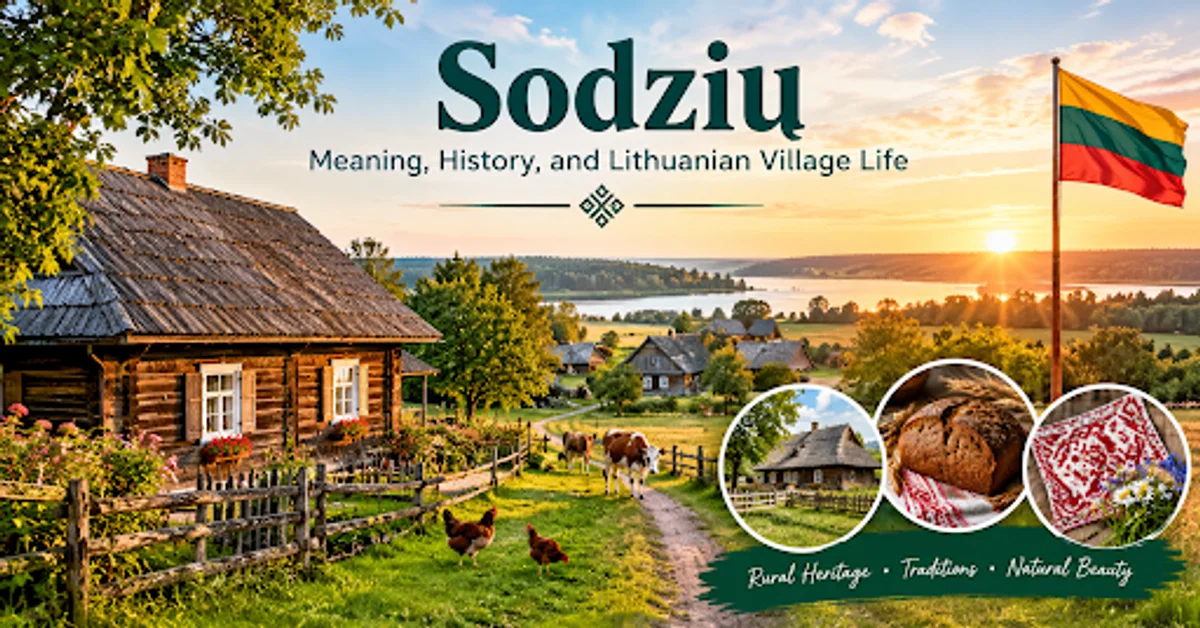
Sodziu is generally used online as an unaccented spelling associated with sodžius, a Lithuanian word meaning a village or rural settlement. The term connects with traditional countryside communities where households historically depended on agriculture, livestock, gardens, and nearby natural resources.
The broader cultural associations of Sodziu include village relationships, family farm, traditional homes, and local customs. Although these ideas help explain its significance, they are cultural associations rather than a complete dictionary definition. The precise meaning of a word should always be understood within its linguistic and historical context.
Lithuanian uses special characters, including ž, which appears in the spelling sodžius. When people type on keyboards that lack Lithuanian characters, they sometimes replace these letters with ordinary Latin characters. This helps explain why forms such as Sodziu appear in international searches and online articles.
However, Sodziu should not automatically be treated as a grammatically interchangeable form of sodžius. Lithuanian words can change their endings depending on their role in a sentence. For an English-language article, explaining both the searchable spelling and the standard Lithuanian form helps readers understand the topic without creating confusion.
Related: Aelftech.com: A Complete Guide to Digital Marketing
Sodziu vs. Sodyba vs. Kaimas
Key Differences Between These Lithuanian Terms
The difference between Sodziu, sodyba, and kaimas is important for understanding Lithuanian village culture. Sodžius refers to a village or rural settlement, while kaimas is another common Lithuanian word for a village or countryside settlement. Their meanings overlap, although their use can vary by context and historical period.
By comparison, sodyba usually refers to an individual homestead or farmstead. It may include a house, garden, farmland, barns, and other buildings associated with one property. A village can contain multiple homesteads, so the distinction is similar to the difference between a settlement and an individual rural property.
Common Misunderstandings About Sodziu
One common mistake is using sodybos as the plural of sodžius. These are different Lithuanian words: sodybos is the plural form of sodyba, whereas sodžius has its own grammatical forms. Recognizing this difference makes discussions of Lithuanian rural settlements more accurate.
Another misunderstanding is assuming that Sodziu refers to a specific business, modern lifestyle product, or traditional textile technique. The established linguistic meaning points toward village life. Claims about other meanings require independent evidence rather than repetition across websites.
The History of Sodziu in Lithuania
Traditional Village Settlements and Agriculture
The history of Sodziu is closely connected with the development of Lithuanian rural settlements. Historical sources describe sodžius as a type of rural settlement that existed during the medieval period, particularly between the 12th and 16th centuries. These settlements developed as people established homes near fields and organized their lives around agriculture and access to natural resources.
Traditional farming shaped village organization, family responsibilities, and relationships between neighbors. Households cultivated land, raised livestock, stored food, and maintained buildings using locally available materials. Over time, changes in land management transformed settlement patterns, and many older settlements in Aukštaitija were reorganized into more regular village layouts during the 16th century.
How Modernization Changed Lithuanian Rural Life
Lithuanian village life continued to change through political reforms, industrial development, and shifts in land ownership. The Soviet period brought major agricultural reorganization and collectivization, changing how farms were managed and how rural communities worked. These changes affected traditional household farming and the structure of countryside settlements.
After Lithuania restored independence in 1990, private property, new agricultural businesses, migration, and stronger connections with European markets influenced rural communities again. Modern villages now combine historical traditions with contemporary housing, transport, technology, and employment. This history shows that Sodziu is best understood as part of an evolving rural landscape rather than a lifestyle that has remained unchanged for centuries.
Traditional Sodziu Village Life
Daily Routines, Family Life, and Community Values
Traditional Lithuanian village life often revolved around the household, the farm, and the surrounding landscape. Daily activities included preparing meals, tending gardens, caring for animals, maintaining buildings, collecting firewood, and producing items needed at home. Family members commonly shared responsibilities according to age, experience, and the demands of the season.
Village communities also depended on cooperation. Neighbors could help with demanding agricultural work, building repairs, and important family occasions. Weddings, religious gatherings, markets, and seasonal celebrations created opportunities to strengthen social relationships. These connections formed an important part of Lithuanian rural heritage, although daily experiences differed according to region, wealth, family structure, and historical period.
Seasonal Work and Rural Traditions
The agricultural calendar influenced almost every part of traditional countryside life. Spring was associated with preparing fields and planting crops, while summer involved gardening, haymaking, and caring for growing plants. Autumn brought harvesting and preserving food, and winter provided opportunities for indoor crafts, equipment repairs, and other household tasks.
These seasonal routines encouraged people to develop practical knowledge of soil, weather, animals, and plants. Skills passed between generations helped families adapt to local conditions and prepare for difficult periods. Today, traditional agricultural practices remain valuable for understanding how rural communities used their time, managed resources, and maintained connections with the land.
Lithuanian Rural Homes and Architecture
Traditional Wooden Houses and Farmsteads
Lithuanian rural architecture reflects the practical needs of households living through cold winters and changing seasons. Wood was widely used for houses and agricultural buildings because it was available locally and suitable for traditional construction. Depending on the property, a rural homestead could contain a main house, barn, storage building, animal shelter, garden, and other structures.
Traditional homes also supported cooking, heating, food storage, and family activities. Stoves helped keep interiors warm, while cellars and storage areas helped preserve supplies. Architectural styles varied between Lithuania’s ethnographic regions, so traditional houses did not all share the same layout or decoration.
The Role of Sodyba in Countryside Living
The word sodyba is particularly useful when discussing Lithuanian homesteads. Unlike sodžius, which can refer to a village or rural settlement, sodyba normally describes an individual homestead or farmstead. Its buildings and surrounding land formed a practical setting for household life, agriculture, and food production.
Some historical properties have survived through restoration and continued use. For example, the ethnographic village of Zervynos in Dzūkija preserves traditional wooden buildings, decorative details, and a historic settlement environment. Such places help visitors understand Lithuanian rural architecture while supporting cultural preservation and heritage education.
Farming, Food, and Traditional Crafts
Agriculture, Gardening, and Beekeeping
Farming was central to traditional Sodziu rural culture. Households grew crops suited to local soil and weather, maintained vegetable gardens, and raised animals for food, transport, and agricultural work. Rye was especially important because it provided grain for bread, while potatoes, vegetables, dairy products, and other local foods helped sustain families.
Beekeeping also contributed to rural life. Honey served as a food, while beeswax had practical uses. In regions such as Aukštaitija, visitors can explore this history through countryside attractions, including the Museum of Ancient Beekeeping in Stripeikiai. Forest gathering was another valuable activity, particularly in Dzūkija, where mushrooms and berries remain associated with regional food traditions.
Lithuanian Traditional Foods and Handmade Crafts
Traditional Lithuanian cuisine developed around ingredients that households could grow, raise, gather, or preserve. Juoda duona, meaning dark bread, reflects the longstanding importance of rye in Lithuanian food culture. Food preservation methods such as drying mushrooms, fermenting vegetables, and storing root crops helped households prepare for winter.
Other well-known Lithuanian dishes include cepelinai, potato dumplings often filled with meat or curd, and šaltibarščiai, a refreshing cold beet soup. These foods belong to Lithuanian cuisine broadly rather than exclusively to Sodziu communities. Traditional crafts, including weaving, embroidery, woodworking, and the making of household tools, also demonstrate how practical skills became part of the country’s cultural identity.
Nature, Folklore, and Village Celebrations
Forests, Folk Songs, and Traditional Beliefs
The Lithuanian countryside includes forests, lakes, rivers, meadows, and agricultural land that have influenced local traditions for generations. These landscapes supplied food, building materials, medicinal plants, and other resources. Mushroom and berry gathering remains especially associated with Dzūkija, a southeastern region known for its forests, wetlands, and strong foraging traditions.
Baltic folklore adds another dimension to this relationship with nature. Stories, legends, proverbs, and Lithuanian folk songs preserved community memories and expressed ideas about family, work, love, and the natural world. Oral traditions helped pass cultural knowledge from older generations to younger ones, although particular stories and customs differed across regions.
Joninės, Kūčios, and Other Lithuanian Festivals
Lithuanian village traditions include celebrations connected with the seasons, family life, and religion. Joninės, the midsummer celebration associated with the summer solstice, is known for bonfires, singing, flower wreaths, and outdoor gatherings. Its customs combine older seasonal traditions with later Christian associations.
Kūčios, the traditional Christmas Eve meal, emphasizes family gathering and food customs, while Užgavėnės is a pre-Lenten celebration known for masks, costumes, and lively performances. These festivals demonstrate how Lithuanian cultural heritage brings people together. Their customs are not identical in every village, but they continue to connect contemporary communities with historical traditions.
Sodziu in Modern Lithuania
Rural Tourism and Cultural Heritage Preservation
Sodziu remains relevant to visitors interested in rural tourism and traditional Lithuanian villages. Travelers can explore restored homesteads, ethnographic settlements, regional museums, traditional foods, and craft demonstrations. Some countryside properties also offer nature walks, cycling, fishing, sauna experiences, and opportunities to learn about rural life.
Heritage destinations such as Zervynos and Vaišnoriškės provide examples of how historical settlements can be preserved and interpreted for visitors. Rural tourism may generate income for local communities while supporting the restoration of traditional buildings and the continuation of local skills. Visitors should remember that each destination offers a different experience rather than a single, universal picture of Lithuanian village life.
Sustainable Living and the Future of Lithuanian Villages
Modern rural Lithuania combines traditional knowledge with contemporary technology. Some households continue gardening, preserving food, repairing useful items, and purchasing products locally. These practices share similarities with current sustainability principles, although traditional village life should not automatically be described as organic or completely waste-free.
The future of rural communities also depends on employment, transport, education, healthcare, housing, and internet access. Renewable energy, modern agricultural equipment, and digital services can create new opportunities when they suit local needs. Preserving Lithuanian rural heritage is therefore not about preventing change; it is about helping communities develop while retaining meaningful connections with their history.
Is Sodziu a Traditional Fabric-Dyeing Technique?
Examining Online Claims About Sodziu
Some online articles describe Sodziu as an ancient fabric-dyeing technique involving natural pigments, indigo, wax, or resist-dyeing methods. Although traditional textile crafts are genuine parts of many European cultures, the existence of these techniques does not establish Sodziu as their recognized name.
Readers should be cautious when a website presents an unusual definition without naming a reliable dictionary, museum, academic publication, or documented craft tradition. Repeated claims across websites do not necessarily establish historical accuracy. This distinction is particularly important when researching unfamiliar cultural terms.
What Reliable Lithuanian Language Sources Tell Us
Lithuanian dictionary and encyclopedia entries associate sodžius with a village or historical rural settlement. The Universal Lithuanian Encyclopedia also describes a historical settlement type called sodžius and explains how some settlements later developed into more regular villages. These sources support the linguistic and historical interpretation rather than the fabric-dyeing claim.
The most reliable conclusion is that Sodziu, when used as a simplified spelling of sodžius, belongs to the vocabulary of Lithuanian rural settlements. If a textile-related use appears elsewhere, it should be supported by separate, credible evidence before being presented as an established tradition.
Why Sodziu Still Matters Today
Preserving Lithuanian Rural Identity and Traditions
Sodziu provides a useful way to explore the rural history that helped shape Lithuanian society. Traditional settlements supported farming, family life, local food production, craftsmanship, folklore, and community celebrations. Their buildings and customs offer insight into how people adapted to their surroundings and responded to historical change.
Museums, heritage programs, local festivals, and restored homesteads help preserve this knowledge. Protecting historic architecture and recording traditional songs, recipes, and crafts can keep these traditions accessible to future generations. Cultural preservation works best when local communities participate and receive meaningful benefits from the process.
Connecting Historical Village Life With Modern Culture
Lithuanian rural heritage remains relevant because it connects historical knowledge with contemporary interests in culture, architecture, food, and nature. Visitors may discover traditional settlements while traveling, while residents can maintain family customs or support local crafts and agricultural businesses.
At the same time, modern villages need the same essential opportunities as other communities. A positive future for Sodziu heritage depends on balancing preservation with comfortable housing, education, jobs, public services, and innovation. This approach respects the past without treating rural communities as places that should remain unchanged.
Related: Glorvix.com: Services, Safety, and Legitimacy
Frequently Asked Questions
What does Sodziu mean?
Sodziu is commonly used online as a simplified spelling of the Lithuanian word sodžius, meaning a village or rural settlement.
Is Sodziu a Lithuanian word?
The standard Lithuanian form is sodžius. Sodziu is an unaccented spelling that may appear in online searches, although it is not necessarily grammatically interchangeable with the original word.
What is the difference between Sodziu and sodyba?
Sodžius refers to a village or rural settlement, while sodyba usually means an individual homestead or farmstead.
Is Sodziu the same as kaimas?
The meanings overlap. Kaimas is a common Lithuanian word for a village, while sodžius can carry historical or traditional rural associations.
Is Sodziu a traditional fabric-dyeing technique?
Reliable Lithuanian language sources identify sodžius with village settlements, not a recognized fabric-dyeing technique. The alternative claim requires credible supporting evidence.
What traditions are associated with Lithuanian village life?
Traditional village culture includes farming, bread-making, food preservation, crafts, folk songs, seasonal celebrations, and connections with forests and other natural resources.
Can visitors experience traditional Lithuanian rural culture?
Yes. Visitors can explore ethnographic villages, restored homesteads, regional museums, traditional food, craft demonstrations, and countryside landscapes.
Summary
Sodziu is best understood as a simplified spelling associated with the Lithuanian word sodžius, meaning a village or rural settlement. Its cultural significance opens a window into Lithuania’s rural history, traditional architecture, farming practices, cuisine, folklore, and seasonal celebrations.
Although Lithuanian villages have changed considerably over time, their heritage remains visible through historic settlements, restored homesteads, local traditions, and rural tourism. Understanding the distinction between sodžius, kaimas, and sodyba also helps prevent common linguistic misunderstandings.
Ultimately, Sodziu represents a valuable starting point for exploring Lithuania’s countryside heritage—a history shaped by the land, strengthened by community, and carried forward through both preservation and positive change.