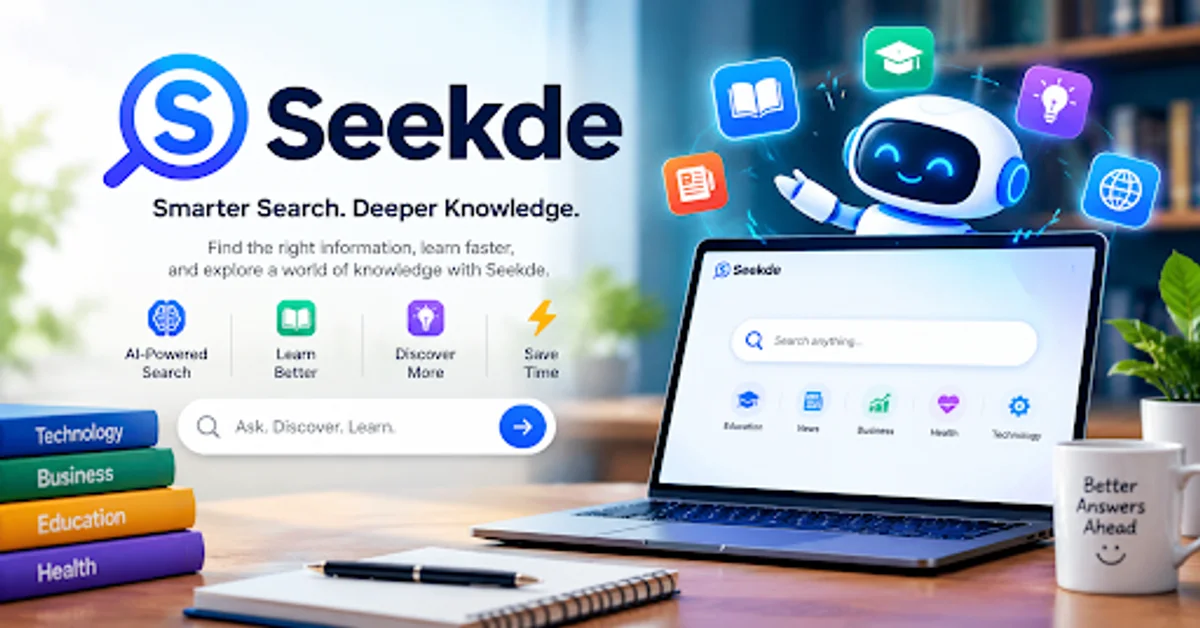
Seekde does not have one universally accepted dictionary definition. Online descriptions associate the name with searching, knowledge discovery, and intelligent information retrieval. Its precise origin is not consistently documented, so it is best understood through its use in the digital discovery context.
The Seekde platform is described as an approach to finding information that emphasizes meaning, context, and connections. Instead of focusing only on matching keywords, this approach aims to help users explore subjects more clearly. Its value ultimately depends on the features the platform actually provides.
The main idea behind Seekde digital discovery is to make online exploration more purposeful. Users often need more than a quick answer; they may want background information, related concepts, supporting evidence, and links to original sources. A discovery-focused system can help organize these elements into a clearer research experience.
This approach may benefit students, professionals, researchers, and curious learners. By exploring related ideas and examining source material, users can build a stronger understanding of complicated subjects rather than relying on isolated facts.
Related: Quad Equalizer: A Complete Guide to Better Sound
How Does Seekde Work?
Contextual Discovery and Search Intent
Contextual discovery focuses on understanding what a person wants to accomplish through a search. For example, someone searching for renewable energy may want to learn about solar technology, installation costs, environmental benefits, or government policies. Understanding the context can help organize information around the user’s actual goal.
Seekde is associated with this intent-focused approach. However, the quality of contextual results depends on the platform’s underlying technology and implementation. Users should write clear questions, review the results, and refine their searches when the information does not fully address their needs.
Knowledge Mapping and Connected Information
Knowledge mapping organizes related concepts so users can understand how different ideas influence one another. When researching climate change, for instance, a knowledge map might connect greenhouse gases, energy production, temperature changes, and environmental policies.
A related concept is the Knowledge Graph, which represents relationships between entities and information. If Seekde implements comparable techniques, they could help users navigate complicated subjects more efficiently. The availability and depth of any such feature should be confirmed through current platform documentation.
Key Features of Seekde
Trustworthy Sources and Information Transparency
Source transparency helps users identify where information originates, who published it, and when it was updated. These details are essential when comparing conflicting claims or deciding whether a source deserves further attention. Seekde’s stated emphasis on trustworthy information reflects this important principle.
Nevertheless, a platform’s commitment to transparency does not automatically guarantee accuracy. Users should examine authorship, publication dates, evidence, and original references. Information from official organizations, peer-reviewed research, and primary documents can provide stronger support for important claims.
Adaptive Learning and Personalized Discovery
Adaptive learning describes systems that adjust their behavior using information from interactions or feedback. In a discovery environment, personalization could help users explore subjects related to their interests and previous research activities.
Seekde is described as aiming to provide a more adaptive discovery experience. The extent to which it currently learns from users, remembers preferences, or personalizes results requires verification. Users should also consider privacy policies before sharing personal information with any digital platform.
Seekde and AI-Powered Search
How Artificial Intelligence Supports Information Discovery
Artificial Intelligence (AI) is changing how people discover and understand information. AI-assisted systems can interpret questions, summarize documents, identify patterns, and organize relevant material. Natural Language Processing (NLP) helps computers process human language, while Machine Learning can identify patterns in data and improve certain system functions.
Seekde is commonly described in AI-assisted discovery discussions, but its precise technical architecture should not be assumed without reliable documentation. AI-powered information discovery can be helpful, yet its results still require evaluation because automated systems may misunderstand questions, omit context, or produce inaccurate summaries.
The Role of Semantic Search in Understanding Queries
Semantic Search focuses on the meaning and context of a query rather than relying exclusively on exact keyword matches. For example, a search about reducing household electricity bills may relate to insulation, energy-efficient appliances, and solar panels, even if those terms do not appear in the original question.
This approach can improve search result relevance when implemented effectively. It can also support more natural interactions, allowing users to ask complete questions instead of guessing which keywords will produce the right results. However, the actual quality of semantic search varies between platforms.
Benefits of Using Seekde
Reducing Information Overload
Information overload occurs when people encounter more material than they can reasonably evaluate. Search engines can return many pages, articles, videos, and discussions, leaving users to decide which information matters most.
A discovery platform that groups relevant information and highlights connections may reduce this burden. Seekde’s proposed approach could help users move from broad questions toward specific topics. Its effectiveness, however, depends on how well it organizes results and distinguishes relevant sources from weaker material.
Improving Research and Learning Efficiency
Research efficiency improves when users can locate useful material, understand its context, and identify the next steps without repeatedly starting new searches. Connected information can make it easier to develop research questions, compare explanations, and identify gaps in understanding.
Seekde’s focus on structured discovery may support this process. Students could use it to explore a subject, while professionals might use discovery tools to investigate unfamiliar concepts. The best results come from combining digital tools with critical thinking and direct examination of evidence.
Who Can Benefit From Seekde?
Seekde for Students and Researchers
Students often need to understand definitions, theories, examples, historical background, and relationships between concepts. A discovery-focused platform may help them organize these elements and identify promising sources for further study.
Researchers may also benefit from structured exploration when entering an unfamiliar field. Still, Seekde should not replace academic databases, original research papers, or institutional resources. Users should confirm quotations, statistics, and scientific claims against the original publications before including them in assignments or research.
Seekde for Professionals and Lifelong Learners
Professionals regularly encounter new technologies, industry changes, and unfamiliar business concepts. An organized discovery experience could help them understand a topic before consulting specialized documentation or making decisions.
Lifelong learners may appreciate the ability to explore related subjects at their own pace. Whether someone is learning a language, studying history, or exploring digital marketing, the most useful approach combines accessible explanations with trustworthy source material and continued independent learning.
Seekde vs. Traditional Search Engines
Key Differences in Search and Discovery
Traditional search engines such as Google Search are designed to help users find web pages, websites, images, news, and other online resources. Their established search functions are useful when someone knows what they want and needs to locate a specific source quickly.
Seekde is presented as a more discovery-oriented approach, emphasizing context, connected knowledge, and information transparency. Other services, including ChatGPT Search, Perplexity AI, and Microsoft Copilot, also offer AI-assisted ways to explore information. Their features differ, so Seekde should not be assumed to provide capabilities equivalent to those services.
Choosing the Right Approach for Your Needs
The right search method depends on the task. Traditional search may be appropriate when locating an official website, finding a particular document, or comparing several direct sources. AI-assisted tools may be useful when seeking an initial explanation or exploring connections between unfamiliar ideas.
For complicated research, using multiple approaches can be more effective than depending on one platform. Users can begin with an exploratory question, locate original sources through search engines, and compare the evidence before reaching a conclusion.
Is Seekde Reliable and Safe?
Evaluating Sources and Verifying Information
The question “Is Seekde reliable?” cannot be answered solely from its stated goals. Reliability depends on the accuracy of its results, the quality of its sources, the transparency of its methods, and how consistently its information is maintained.
Before relying on a result, check the author’s qualifications, publication date, evidence, and references. For medical, financial, legal, and other high-impact subjects, consult qualified professionals and authoritative sources. Treat platform-generated summaries as starting points rather than definitive proof.
Understanding the Limitations of AI-Assisted Search
AI-assisted search can produce incomplete explanations, misinterpret source material, or present outdated information. Even when a response includes references, those references should be opened and checked to confirm that they genuinely support the claims being made.
Users should also review a platform’s privacy policy, data-handling practices, and security information before submitting sensitive material. A secure connection alone does not establish that a service is trustworthy. Seekde’s actual safety and reliability should be assessed using verifiable evidence rather than promotional descriptions.
How to Use Seekde Effectively
Writing Clear Questions for Better Discovery
To understand how to use Seekde, begin with a clear question that explains your research goal. Instead of entering a broad phrase such as “solar energy,” try asking how residential solar panels work, what affects their cost, or how they compare with other energy sources.
Specific questions make it easier to judge whether the information addresses your needs. If the first results are too broad, narrow the subject or ask a follow-up question. Where the platform supports contextual exploration, use related topics to develop a more complete understanding.
Exploring Related Topics and Original Sources
Good research does not end with the first useful answer. Explore related concepts, compare different explanations, and identify the original documents behind important claims. This process helps distinguish well-supported information from assumptions or repeated claims without evidence.
Online research tools are most effective when they support independent verification. Keep track of useful sources, record publication details, and check whether newer information has changed the picture. These habits improve research quality regardless of which discovery platform you use.
The Future of Seekde and Intelligent Search
Emerging Trends in Digital Knowledge Discovery
Digital discovery is moving toward more conversational search, semantic understanding, and AI-assisted summaries. Users increasingly expect technology to explain complicated topics and connect related information instead of merely presenting a long list of links.
Several related technologies may influence this direction. Retrieval-Augmented Generation (RAG), for example, combines information retrieval with generative AI to help produce responses grounded in retrieved material. These techniques can improve access to relevant information, although their effectiveness depends on the quality of the retrieved sources and the system’s design.
Potential Developments and Future Challenges
Seekde’s future potential depends on its ability to deliver useful results, explain where information comes from, and demonstrate that its features work as described. Better knowledge mapping, improved personalization, and clearer source attribution could make discovery more helpful if implemented reliably.
There are also challenges involving privacy, outdated content, inaccurate summaries, and the evaluation of source quality. Search Engine Optimization (SEO), Generative Engine Optimization (GEO), and Answer Engine Optimization (AEO) are relevant to how publishers make content discoverable across search and AI experiences. However, visibility alone does not guarantee accuracy or usefulness. Sustainable progress will require transparency, reliable evidence, and user trust.
Related: понуде: Meaning, Translation, and Uses
Frequently Asked Questions
What Is Seekde Used For?
Seekde is described as a digital discovery platform focused on contextual search, knowledge mapping, and connected information. Its intended purpose is to help users explore topics more meaningfully.
Is Seekde an AI Search Platform?
Seekde is commonly described as an AI-assisted or AI-powered discovery platform. Its specific technologies and currently available capabilities should be confirmed through official documentation.
What Are the Main Benefits of Seekde?
Its proposed benefits include organized information, contextual discovery, easier exploration of related concepts, and greater attention to source transparency.
Is Seekde Safe to Use?
Safety depends on the actual website, its security practices, and its data policies. Review the official domain and privacy information, and avoid sharing sensitive information unnecessarily.
How Is Seekde Different From Google Search?
Google Search primarily helps users locate online resources, while Seekde is presented as emphasizing connected knowledge and contextual discovery. The practical difference depends on the features each service currently provides.
Summary
Seekde represents an emerging approach to digital discovery that emphasizes search intent, contextual understanding, knowledge mapping, and trustworthy information. These ideas address a genuine challenge: helping people move beyond finding information toward understanding it.
For students, researchers, professionals, and lifelong learners, discovery-focused tools may make complex topics easier to explore. However, Seekde’s actual capabilities and reliability should be evaluated through verifiable documentation and practical experience. By combining intelligent search with source verification and critical thinking, users can make more informed decisions and get greater value from the information available online.