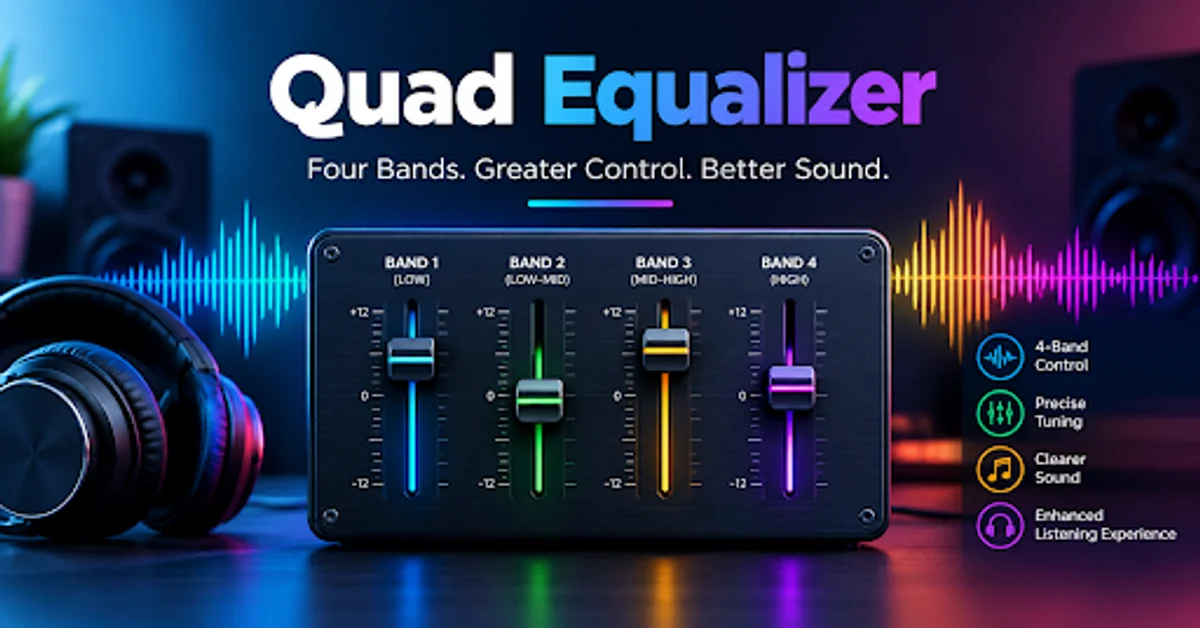
Quad Equalizer is an audio equalization tool that controls four frequency bands, commonly described as bass, low-mid, high-mid, and treble. Each band affects a different part of the sound spectrum, allowing you to change the tonal balance of music, speech, and instruments.
The purpose is not simply to make audio louder. Instead, an equalizer (EQ) helps you emphasize useful details or reduce frequencies that make sound muddy, thin, or unpleasant. You may find quad EQ audio controls in music software, mixing consoles, car audio systems, and guitar amplifiers.
A basic bass-and-treble control offers two broad adjustments. A four-band EQ adds more control over the middle frequencies, where vocals, guitars, piano, and many other instruments contain important details.
This additional control makes it easier to balance sound without overwhelming the entire mix. However, the exact capabilities depend on the device. Some four-band equalizers use fixed frequency ranges, while others allow you to select specific frequencies for more precise adjustments.
Related: Metronidasool: Uses, Dosage, and Side Effects
How Does a Quad Equalizer Work?
Understanding Frequency, Gain, and Decibels
Sound contains vibrations at different frequencies, measured in hertz (Hz). Lower frequencies are generally perceived as bass, while higher frequencies contribute to treble. A Quad Equalizer changes the level of selected frequencies through gain control, usually measured in decibels (dB).
A positive gain value boosts a frequency band, while a negative value reduces it. At 0 dB, the EQ applies no boost or cut to that band. For example, reducing a muddy low-mid range by 2 dB may improve clarity without making the overall sound dramatically different.
How EQ Adjustments Affect Sound Quality
Equalization changes a sound system’s frequency response, meaning how strongly it reproduces different frequencies. A small adjustment can help vocals stand out, reduce excessive bass, or make dull audio sound brighter.
Digital signal processing allows software equalizers to perform these changes electronically. Hardware equalizers use their own circuits to shape the signal. In either case, results depend on the recording, speakers, headphones, room, and settings. EQ can improve tonal balance, but it cannot fully repair every recording or hardware problem.
Understanding the Four Frequency Bands
Bass and Low-Mid Frequency Controls
The bass band typically influences low frequencies, often around 20–250 Hz, including kick drums, bass guitar, and deep musical tones. A modest boost can add weight and impact, while a cut can reduce excessive rumble. Too much bass, however, may overpower vocals and make the entire mix feel heavy.
Low-mid frequencies commonly cover a broad region around 250 Hz–2 kHz, although actual crossover points vary by equalizer. This range contributes to the warmth and body of voices and instruments. Excessive energy can make audio sound boxy or muddy, so a small reduction may help separate sounds and improve definition.
High-Mid and Treble Frequency Controls
High-mid frequencies often cover approximately 2–6 kHz. This range contributes to vocal intelligibility, guitar presence, and instrument attack. A small boost may help a singer sound clearer, but too much can make voices, cymbals, and guitars tiring or sharp.
Treble typically covers the upper frequencies, often around 6–20 kHz. It contributes to brightness, air, and fine detail. A slight treble boost may help a dull recording, while a cut can soften excessive hiss or sharpness. These frequency ranges are approximate; the controls on your specific device determine the actual response.
Types of Quad Equalizers
Graphic and Parametric Quad Equalizers
A graphic Quad Equalizer usually provides four fixed frequency bands with separate sliders or knobs. Each control changes the level of its assigned range. This design is straightforward and useful for everyday listening, basic speaker tuning, and quick tonal adjustments.
A parametric equalizer offers greater flexibility by allowing users to adjust frequency, gain, and Q factor. The Q factor determines how wide or narrow the adjustment is. A narrow adjustment can target a particular problem frequency, while a wider adjustment shapes a broader part of the sound. A four-band parametric EQ still has four main bands, but each can offer much more control than a fixed graphic EQ.
Semi-Parametric Equalizers and Their Features
A semi-parametric equalizer combines simple controls with some adjustable parameters. It may let you change the frequency and gain of a middle band without providing a variable Q control. This makes it a practical option for users who want more flexibility without dealing with complex settings.
Semi-parametric equalizers are common in audio mixing consoles and some instrument amplifiers. Audio equipment manufacturers such as Yamaha and Roland offer products with different EQ designs. Always check the specifications of an individual model rather than assuming every product from a brand has the same four-band layout.
Key Features of a Quad Equalizer
Frequency, Gain, and Q Factor Controls
Frequency control determines which part of the sound spectrum a band affects. Gain determines how much that range is boosted or reduced. Together, these controls let you shape bass, midrange, and treble to suit your equipment and listening preferences.
The Q factor controls bandwidth adjustment on models that support it. A low Q value generally affects a wider frequency range, while a high Q value affects a narrower range. Fixed-band equalizers may not offer this feature, so the available controls depend on the design.
EQ Bypass, Filters, and Bandwidth Settings
An EQ bypass switch temporarily disables equalization so you can compare the processed sound with the original. This is especially useful when evaluating whether an adjustment genuinely improves clarity rather than merely changing the tone or perceived loudness.
Some advanced models also offer shelf and bell filters. A shelf filter changes a broad range of frequencies above or below a selected point, while a bell filter focuses its effect around a particular frequency. Not every four-band equalizer includes these features, so check the product specifications before buying.
Common Uses of a Quad Equalizer
Quad Equalizer for Music Production and Recording
A Quad Equalizer for music production helps shape vocals, drums, guitars, keyboards, and bass during recording and mixing. Producers may reduce low-mid buildup in a vocal recording or adjust high-mid frequencies to make an instrument more distinct. These small changes can help create a balanced mix.
EQ is also useful for addressing frequency masking, which occurs when overlapping sounds make one source harder to hear. During music mixing and mastering, however, EQ is only one part of the process. Level balance, arrangement, compression, room acoustics, and monitoring quality also influence the final result. Resources from professional audio organizations and manufacturers such as Shure can provide further guidance on microphone placement and recording techniques.
Quad Equalizer for Car Audio and Guitar Amplifiers
A Quad Equalizer for car audio helps compensate for tonal preferences and differences in speaker placement. You might reduce excessive bass, improve vocal presence, or soften bright speakers. Because vehicle interiors affect reflections and frequency response, settings that sound good in one car may not work in another.
A Quad Equalizer for guitar amp use typically offers bass, low-mid, high-mid, and treble controls. Reducing low-mid frequencies may help a guitar sound less thick in a band mix, while a modest high-mid adjustment can improve note definition. Guitarists should experiment at realistic playing volumes, as amplifier and speaker behavior can change with volume.
Quad Equalizer vs. Other Equalizers
Differences Between 3-Band, 4-Band, and 5-Band EQ
A 3-band EQ typically controls bass, midrange, and treble. It is simple to operate but offers limited control over the different parts of the middle frequencies. A 4-band equalizer separates the midrange into two areas, giving users more options for improving vocal clarity and instrument balance.
A 5-band EQ adds another control for more detailed adjustments. However, the number of bands alone does not determine sound quality. Frequency selection, filter design, room acoustics, and the quality of the audio equipment also influence the results.
Quad Equalizer vs. 10-Band Equalizer
A 10-band equalizer divides the sound spectrum into more sections, allowing more targeted adjustments. It may be useful for detailed headphone customization, speaker correction, and addressing specific tonal problems.
A Quad Equalizer is often easier to operate because it uses fewer controls. For everyday listening, basic car stereo tuning, and guitar amplification, four bands may provide enough flexibility. Choose a 10-band EQ when you need more detailed control, not simply because it has more sliders.
Common Quad Equalizer Problems and Solutions
Fixing Muddy Audio, Harsh Vocals, and Weak Bass
Muddy audio may result from excessive bass, crowded low-mid frequencies, room acoustics, or the recording itself. Try a small low-mid cut and listen for improved separation. If vocals sound harsh, experiment with reducing high-mid frequencies before making broader treble changes.
Weak bass does not always mean the bass control needs boosting. Your speakers may have limited low-frequency capability, or their placement may cause bass cancellation. Check your equipment and listening position before applying large EQ adjustments.
Preventing Distortion and Maintaining Sound Balance
Excessive boosts can reduce available headroom and contribute to clipping or audio distortion, particularly when the signal already approaches the system’s maximum level. If audio becomes rough or breaks up, reduce the boosts and lower the output level when necessary.
Aim for balance rather than maximum intensity. Cutting unwanted frequencies can sometimes improve clarity without increasing the overall signal level. Careful sound engineering involves listening critically, making controlled changes, and checking the result on different playback systems.
Advantages and Limitations of a Quad Equalizer
Main Benefits for Everyday Listening and Audio Mixing
A Quad Equalizer offers a useful balance between simplicity and control. Its four bands let you adjust bass, warmth, vocal presence, and treble without navigating a complicated interface. This makes it suitable for beginners and experienced users who want quick, practical sound adjustments.
Another benefit is versatility. The same basic concept works across headphones, home audio, car systems, mixing consoles, and guitar amplifiers. With sensible settings, a four-band audio equalizer can make music more comfortable to hear and help important details stand out.
Limitations and When to Choose an Advanced EQ
Four bands cannot precisely address every sound problem. If you need to target a narrow resonance, correct several room-related issues, or shape a complex recording, a parametric equalizer with adjustable frequency and Q may be more suitable.
EQ also cannot replace good microphones, capable speakers, appropriate recording techniques, or acoustic treatment. Consider an advanced EQ when you genuinely need its additional controls. Otherwise, a simple four-band design can provide all the adjustment required for your listening or production goals.
Related: Brandihomes.com: A Complete Website Review
Frequently Asked Questions
What is a Quad Equalizer used for?
A Quad Equalizer adjusts four frequency bands to control bass, midrange, vocal clarity, and treble. It is used in music production, car audio, headphones, and guitar amplifiers.
What are the four bands of a Quad Equalizer?
The four bands are bass, low-mid, high-mid, and treble. Their exact frequency ranges depend on the equalizer’s design.
What are the best Quad Equalizer settings?
Start with all bands at 0 dB. Make small adjustments based on the recording, speakers, and listening environment. There is no single setting that works best for every system.
Is a Quad Equalizer better than a 10-band EQ?
Neither is universally better. A Quad Equalizer is simpler, while a 10-band EQ provides more detailed control over different frequency ranges.
Can a Quad Equalizer improve vocal clarity?
Yes. Carefully reducing muddy low-mid frequencies or making a small high-mid adjustment can help vocals stand out. The best change depends on the recording and playback system.
Summary
A Quad Equalizer is a practical tool for controlling four important frequency areas: bass, low-mid, high-mid, and treble. It helps users improve tonal balance, make vocals clearer, reduce muddiness, and customize sound for different environments.
The best approach is to start at 0 dB, make small adjustments, and compare the result with the original audio. Avoid excessive boosts, and remember that the ideal settings depend on your equipment and the sound you want to achieve.
Choose a graphic Quad Equalizer for straightforward adjustments, a semi-parametric model for additional flexibility, or a parametric four-band EQ for more precise frequency control. Consider which features you will actually use instead of focusing only on the number of bands.
Ultimately, the best equalizer is one that helps you achieve clear, balanced sound without unnecessary complexity. A few thoughtful adjustments can make your listening experience more enjoyable and your audio work more effective.