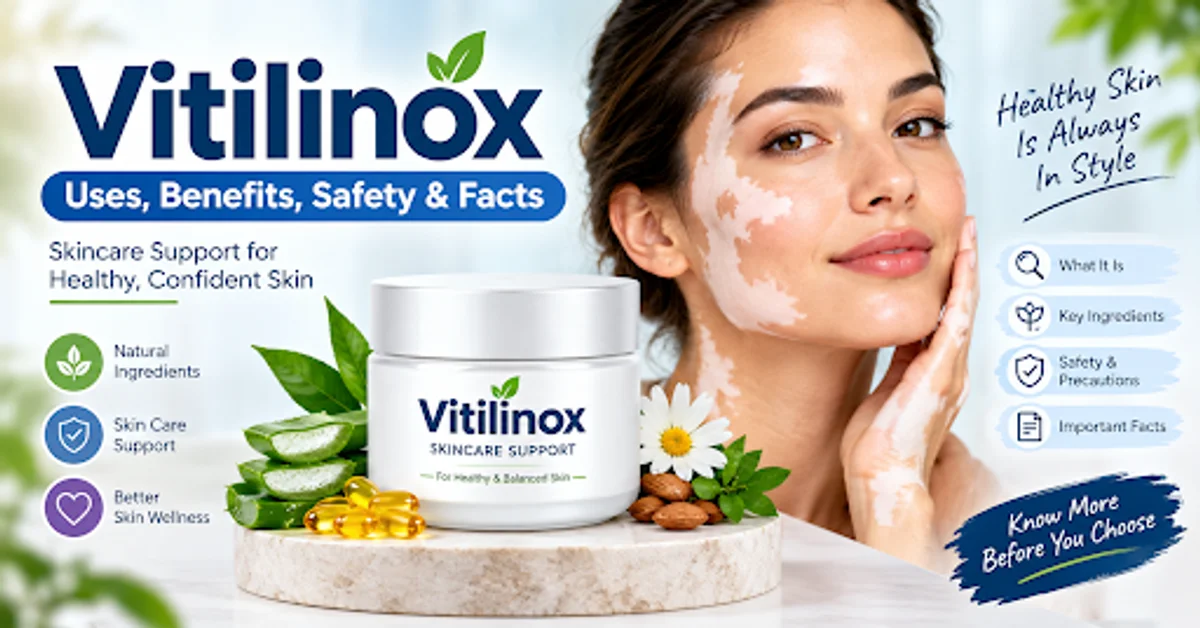
Vitilinox is a name used online in skincare and wellness content in connection with vitiligo, skin pigmentation, and white patches. The available descriptions do not clearly establish Vitilinox as one standardized medical product. Instead, references to the name may describe a cosmetic skincare concept or product with ingredients intended to support general skin care and appearance.
This distinction is important when researching the meaning of Vitilinox. A product associated with a medical condition should have clear information about its manufacturer, formulation, ingredients, intended use, and supporting evidence. In the material available for Vitilinox, these details are not consistently established, so readers should avoid assuming that every product using the name has the same formulation or proven effects.
Vitilinox is associated with vitiligo because its online descriptions focus on pigmentation concerns, including areas of lighter or depigmented skin. Vitiligo is an autoimmune disease in which the body’s immune system affects melanocytes, the cells responsible for producing melanin, the pigment that gives skin its color. The resulting loss of pigment can create noticeable white patches on different areas of the body.
The connection between Vitilinox and vitiligo, however, does not by itself establish that the product treats the underlying condition. Established dermatology guidance approaches vitiligo through diagnosis, sun protection, cosmetic camouflage when desired, and medical treatments such as topical medicines and phototherapy, depending on the individual case. For anyone experiencing new pigmentation loss, consulting a qualified dermatologist is a more reliable starting point than relying solely on online product claims.
Related: Fanquer: AI Writing Tool for Better Content
How is Vitilinox Described?
Vitilinox as a Skincare Product
Available descriptions present Vitilinox skincare as a supportive or cosmetic approach rather than a proven cure for vitiligo. Some descriptions refer to generic skincare ingredients such as Aloe Vera, Vitamin E, and moisturizing oils. However, these descriptions do not establish one definitive Vitilinox formulation.
Moisturizing skincare can be useful for maintaining the skin barrier and overall skin comfort, but moisturization should not be confused with restoration of melanocytes or treatment of the autoimmune process responsible for vitiligo. A cosmetic product can support skin care without being a medical treatment.
Claims Made About Vitilinox
The claims associated with Vitilinox should be separated into three categories: cosmetic skincare claims, supportive claims, and medical treatment claims. A statement that a product moisturizes skin is fundamentally different from a statement that it restores pigmentation or stops vitiligo from progressing.
The available material explicitly describes Vitilinox as not a cure for vitiligo. That limitation is important. Consumers should therefore avoid interpreting terms such as “pigmentation support,” “skin renewal,” or “natural ingredients” as proof that the product can reverse the underlying disease.
Vitilinox Ingredients and Formulation
Ingredients Commonly Associated With Vitilinox
Descriptions of Vitilinox may mention ingredients such as Aloe Vera, Vitamin E, moisturizing oils, Vitamin B12, Folic Acid, Vitamin D3, Ginkgo Biloba, Piperine, Psoralea Corylifolia, Hyaluronic Acid, or Copper Peptides. However, these ingredients should not automatically be treated as confirmed components of every product carrying the Vitilinox name.
The same principle applies to claims about antioxidant ingredients or nutritional support. An individual ingredient may have research associated with skin health or other biological functions, but that does not prove that a particular combination is effective against vitiligo. Ingredient-specific evidence and product-specific evidence are two different things.
Why Formulation Consistency Matters
Vitilinox formulation is one of the most important issues to investigate. If formulations vary depending on the seller, the product name does not provide the consistency consumers normally expect from an established branded product.
A reliable product should make it reasonably easy to identify its ingredient list, manufacturer information, directions, warnings, batch details where appropriate, and other basic information. Formulation consistency allows consumers and researchers to know what they are actually evaluating.
What Is Vitilinox Used For?
Vitilinox and Skin Pigmentation
Vitilinox is presented online in connection with skin pigmentation and concerns involving uneven skin tone or white patches. These descriptions may make the product sound like a targeted solution for pigmentation loss, but cosmetic support should not be confused with proven repigmentation.
In vitiligo, the central issue involves the loss of melanocytes and therefore reduced melanin production. Genuine repigmentation treatments are designed around the biology of the condition and are selected according to factors such as the type, location, extent, and activity of vitiligo.
Vitilinox and Vitiligo-Related Skincare
Vitilinox for vitiligo should therefore be viewed cautiously unless a specific formulation has reliable evidence behind it. Gentle skincare may still have a place in overall skin health, especially because depigmented areas contain less protective melanin and can be more vulnerable to sunburn.
NIAMS recommends protecting vitiligo-affected skin from excessive sun exposure and notes that cosmetics can also be used to camouflage depigmented patches. These practical approaches are different from claiming that a cosmetic product treats the underlying condition.
Does Vitilinox Cure Vitiligo?
What Vitilinox Claims About Vitiligo
The material reviewed for this article directly states that Vitilinox is not considered a cure for vitiligo. This is an important distinction because vitiligo is an autoimmune disease, not simply a problem of dry skin or uneven complexion.
Established medical sources likewise explain that there is currently no simple cure for vitiligo, although treatments can help restore color or make skin tone appear more even for some people.
Cure Claims vs. Supportive Skincare
A supportive skincare product and a medical treatment serve different purposes. A moisturizer may help maintain the skin barrier, while a dermatologist-directed treatment may aim to suppress immune activity or encourage repigmentation.
For this reason, phrases such as Vitilinox benefits, “skin support,” or “pigmentation care” should not be interpreted as evidence that Vitilinox can cure vitiligo. The safest approach is to distinguish cosmetic claims from outcomes demonstrated through clinical studies.
Is There Clinical Evidence for Vitilinox?
Clinical Studies and Dermatological Research
The available Vitilinox material does not cite convincing Vitilinox clinical evidence, clinical trials, or peer-reviewed research demonstrating that the named product treats vitiligo. This does not prove that every ingredient associated with the name is ineffective; it means that product-specific evidence has not been adequately established in the material reviewed.
Clinical trials are important because they test products under defined conditions and allow researchers to examine safety and effectiveness. Peer-reviewed research adds another layer of scrutiny by allowing scientific work to be evaluated by other researchers.
Understanding Evidence-Based Skincare Claims
Evidence-based skincare begins with a clear question: what product was tested, what was in it, how was it used, who participated, and what outcomes were measured? Without those details, it is difficult to know whether a reported Vitilinox result came from the product itself, another treatment, natural changes in vitiligo, or subjective expectations.
The same principle applies to Vitilinox reviews. Personal experiences can be interesting, but individual testimonials cannot replace controlled clinical research. A person may report improvement without establishing why that improvement occurred.
Vitilinox Safety and Product Transparency
Identifying the Manufacturer
One of the biggest questions surrounding Vitilinox safety is identifying the accountable manufacturer. The available material does not clearly establish one specific company responsible for every product using the name Vitilinox.
Manufacturer information matters because consumers need a reliable source for ingredient questions, safety warnings, quality concerns, storage instructions, and adverse reactions. Without clear accountability, it becomes harder to determine whether two products carrying the same name are actually identical.
Checking Ingredients and Product Information
Before considering any Vitilinox product, consumers should check the complete ingredient list, manufacturer or responsible company, contact information, directions, warnings, batch or lot information where applicable, and the exact formulation being purchased.
This is particularly important for products marketed toward a medical condition. If a seller cannot clearly explain what the product contains or who is responsible for manufacturing it, that lack of transparency deserves attention. Product safety begins with knowing what you are actually buying.
How Does Vitilinox Compare With Established Vitiligo Care?
Evidence-Based Vitiligo Treatment Options
Established vitiligo treatment is based on the individual’s condition rather than on a generic product name. NIAMS identifies options including medicated creams such as corticosteroids or calcineurin inhibitors and light-based treatments such as phototherapy.
The NHS similarly describes topical steroids, calcineurin inhibitors, phototherapy, camouflage, and other specialist treatments as possible approaches depending on the person’s circumstances. Narrowband UVB is one form of phototherapy used in dermatological practice for suitable cases.
These treatments are not interchangeable, and each has potential benefits, limitations, and safety considerations. They should be selected with appropriate medical guidance rather than copied from an online product advertisement.
Why Dermatologist Guidance Matters
A dermatologist can examine the skin, establish whether the patches are actually caused by vitiligo, assess disease activity, and discuss appropriate treatment options. Diagnosis may include a detailed examination and, when useful, a Wood’s lamp, which can make depigmented areas easier to distinguish from some other skin conditions.
This professional assessment is valuable because not every white patch represents vitiligo. Once the diagnosis is established, a dermatologist can discuss options such as corticosteroids, calcineurin inhibitors, phototherapy, or other treatments according to the individual’s needs.
How to Evaluate a Vitiligo Skincare Product
Questions to Ask Before Buying
Anyone researching Vitilinox alternatives or another vitiligo-related skincare product can use a simple checklist. Ask who makes the product, whether the formulation is clearly disclosed, whether every seller provides the same formulation, what evidence supports its claims, and whether appropriate warnings and directions are available.
It is also useful to distinguish a cosmetic product from a medical treatment. A product that moisturizes or improves the appearance of skin may have a reasonable cosmetic purpose without treating vitiligo. Clear labeling helps consumers make informed decisions.
Signs of an Unverified Product
Several warning signs deserve attention: no identifiable manufacturer, unclear ingredients, inconsistent formulations, unsupported medical promises, vague references to “research,” or testimonials presented as though they were clinical evidence.
The absence of evidence should not automatically be described as proof of harm or fraud. It means the consumer does not have enough reliable information to establish effectiveness or quality confidently. Consumer awareness and product transparency are therefore essential when evaluating Vitilinox or any similar health-adjacent product.
Related: Pixwox: Complete Guide to Anonymous Instagram Viewing
Frequently Asked Questions
What is Vitilinox?
Vitilinox is a name used in online skincare and wellness content associated with vitiligo and pigmentation concerns. Available descriptions are inconsistent, so the exact product, formulation, and manufacturer should be verified before concluding.
Does Vitilinox cure vitiligo?
No. The material reviewed for this article explicitly states that Vitilinox is not considered a cure for vitiligo. Established medical sources also describe vitiligo as a chronic autoimmune condition for which treatment focuses on managing the condition and, where possible, restoring skin color.
What are Vitilinox ingredients?
Reported descriptions may mention ingredients such as Aloe Vera, Vitamin E, moisturizing oils, and other nutritional or botanical ingredients. However, because formulations may vary, consumers should rely on the exact ingredient label of the specific product rather than assuming that every Vitilinox product contains the same ingredients.
Does Vitilinox work for white patches?
There is not enough product-specific clinical evidence in the reviewed material to establish that Vitilinox can reliably restore pigmentation in white patches. Individual reviews or testimonials should not be considered equivalent to clinical evidence.
Is Vitilinox safe?
Safety depends on the exact formulation, ingredients, manufacturing standards, and how the product is used. Because the available information does not establish one consistent formulation, it is important to verify the product’s complete ingredient list and manufacturer information before use.
Should I see a dermatologist for vitiligo?
Yes. A dermatologist can help confirm the diagnosis and discuss evidence-based options. NIAMS identifies dermatologists as specialists who diagnose and treat vitiligo and notes that treatment may include medicated creams and phototherapy.
Are natural ingredients automatically effective for vitiligo?
No. “Natural” describes an ingredient’s origin, not its proven effectiveness for a particular medical condition. Aloe Vera, Vitamin E, Ginkgo Biloba, or other ingredients should not be considered proven vitiligo treatments unless appropriate research supports the specific claim.
What is the safest way to approach Vitilinox?
Approach it as an unverified skincare/product name unless its manufacturer, formulation, safety information, and clinical evidence can be independently established. For confirmed vitiligo, discuss evidence-based treatment and skincare options with a qualified dermatologist.
Summary
The most useful Vitilinox facts are straightforward. Vitilinox is presented online as a skincare or supportive product associated with vitiligo, but the available material does not establish one standardized manufacturer, consistent formulation, or strong product-specific clinical evidence.
At the same time, vitiligo itself is a well-recognized autoimmune condition involving melanocytes and melanin loss. Established dermatology has several treatment and management options, and professional guidance can help determine which approach is appropriate.
The goal should not be to create unnecessary fear around skincare. Instead, readers should have enough information to make careful, confident decisions. A clearly labeled product with accountable manufacturing and transparent evidence is easier to evaluate than an unclear product name with variable descriptions.
1 thought on “Vitilinox: Uses, Benefits, Safety & Facts”